
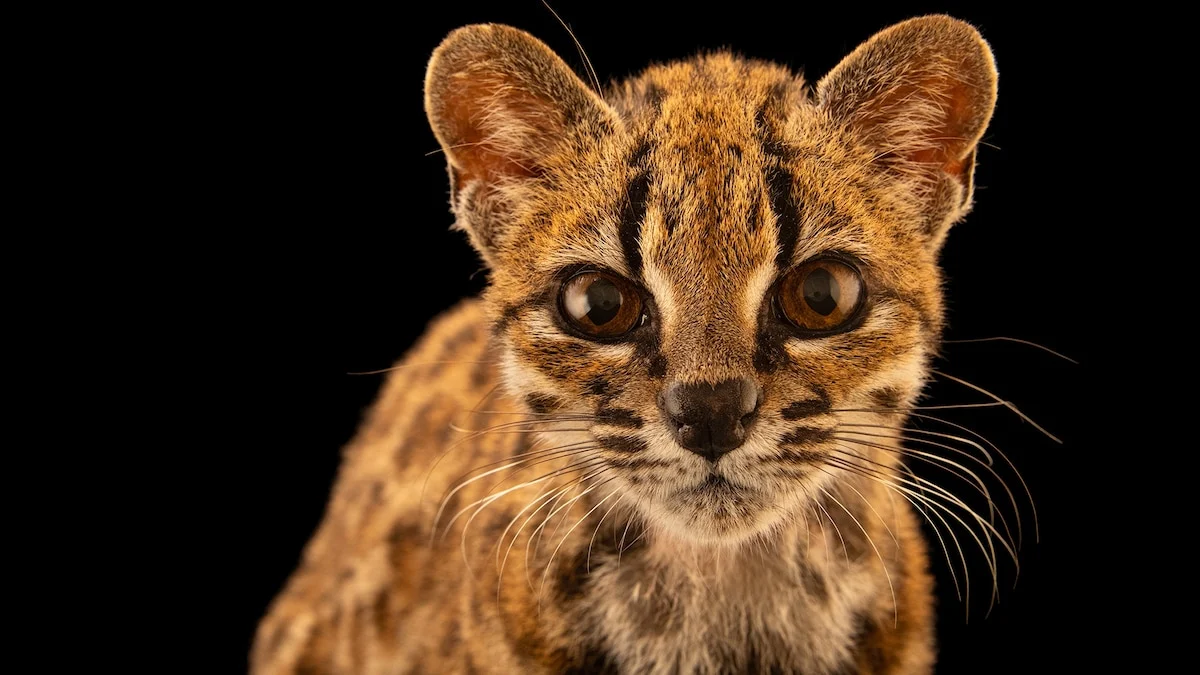
Scientists have formally identified Leopardus tilcayo, a spotted feline from Bolivia's Yungas cloud forests—the first new cat species described in over 100 years.
Scientists have formally identified the first new species of wild cat in more than a century: a three-to-five-pound spotted feline from Bolivia's Yungas cloud forests that locals have long called the tilcayo.
The finding, published Thursday in the journal Current Biology, confirms Leopardus tilcayo as a distinct member of the genus Leopardus—the small, spotted "tiger cats" native to South America. It is the first living cat species to be newly described since the pampas cat was named in 1923.
An accidental discovery
The story began in 2016, when biologist Paola Nogales-Ascarrunz, a National Geographic Explorer and founder of the Bolivian Felids Research Program, received a call from a wildlife sanctuary that had taken in what staff described as "a weird cat." A local man had found it as a kitten on a roadside near a forest, brought it home and raised it for about a year before turning it over to the Senda Verde sanctuary on the subtropical flank of the Bolivian Andes.
Nogales-Ascarrunz initially assumed the animal belonged to Leopardus tigrinus, a look-alike species widely presumed to range across Central and South America. She says she was struck immediately by the cat's small, scrunched face, short round ears, long whiskers and leopard-like rosettes. "I took a hundred pictures of it," she recalled. "I was so fascinated."
It was not until 2019, while preparing a booklet on Bolivia's cats, that she noticed her animal's rosettes were markedly larger than those of reference specimens from neighboring Brazil—a discrepancy she said felt "so wrong."
Genetics settle the question
Distinguishing small wild cats by appearance alone is notoriously unreliable. Many are nocturnal, secretive and nearly impossible to differentiate in trail-camera photos. One museum specimen used in the new research had reportedly been misclassified as a margay before later being identified as a tiger cat.
Working with geneticist Eduardo Eizirik of Brazil's Pontifical Catholic University of Rio Grande do Sul and Jonas Lescroart, an evolutionary ecologist at the University of Antwerp, Nogales-Ascarrunz and her team compared complete genomes from 38 individuals across the Leopardus genus. Results showed L. tilcayo not only differed from all other tiger cat species but had diverged from its closest relative roughly 1.4 million years ago—an evolutionary gap the researchers compare to that between modern lions and extinct cave lions.
The study identifies five distinct tiger cat species in South America, revising a genus that scientists once treated as a single species and later as a species complex. "What we once thought to be a single species, we've started to see that it was actually a species complex," Eizirik said.
A name from local knowledge
The scientific name honors the term used by residents of the region. "We asked the local people, 'Why do you call it tilcayo?'" said Nogales-Ascarrunz, who is Bolivian. "And they said, 'I don't know! My grandpa called it tilcayo, so I call it tilcayo.'" The word does not appear to carry a specific meaning in Spanish or in Quechua.
James Sanderson, founder and director of the Small Wild Cat Conservation Foundation, who was not involved in the study, said the discovery is surprising in itself but that the genomic results "profoundly change how small cat specialists group small cat species in genus Leopardus."
A conservation concern
Much about the animal remains unknown. Researchers can confirm it lives in the Yungas forest ecoregion along the eastern slope of the Andes, but its diet, predators, reproduction and overall population size have yet to be documented. "So many basic things are not known," Nogales-Ascarrunz said.
The authors describe the finding as a reminder of how much biodiversity remains undocumented—and why the habitats that conceal it need protection. "Describing a new cat species after more than 100 years shows how much we still have to learn about the biodiversity around us," Nogales-Ascarrunz said. "But it also reminds us that we need to protect the Yungas forests, which are home to so many species—including some we are only beginning to understand."