
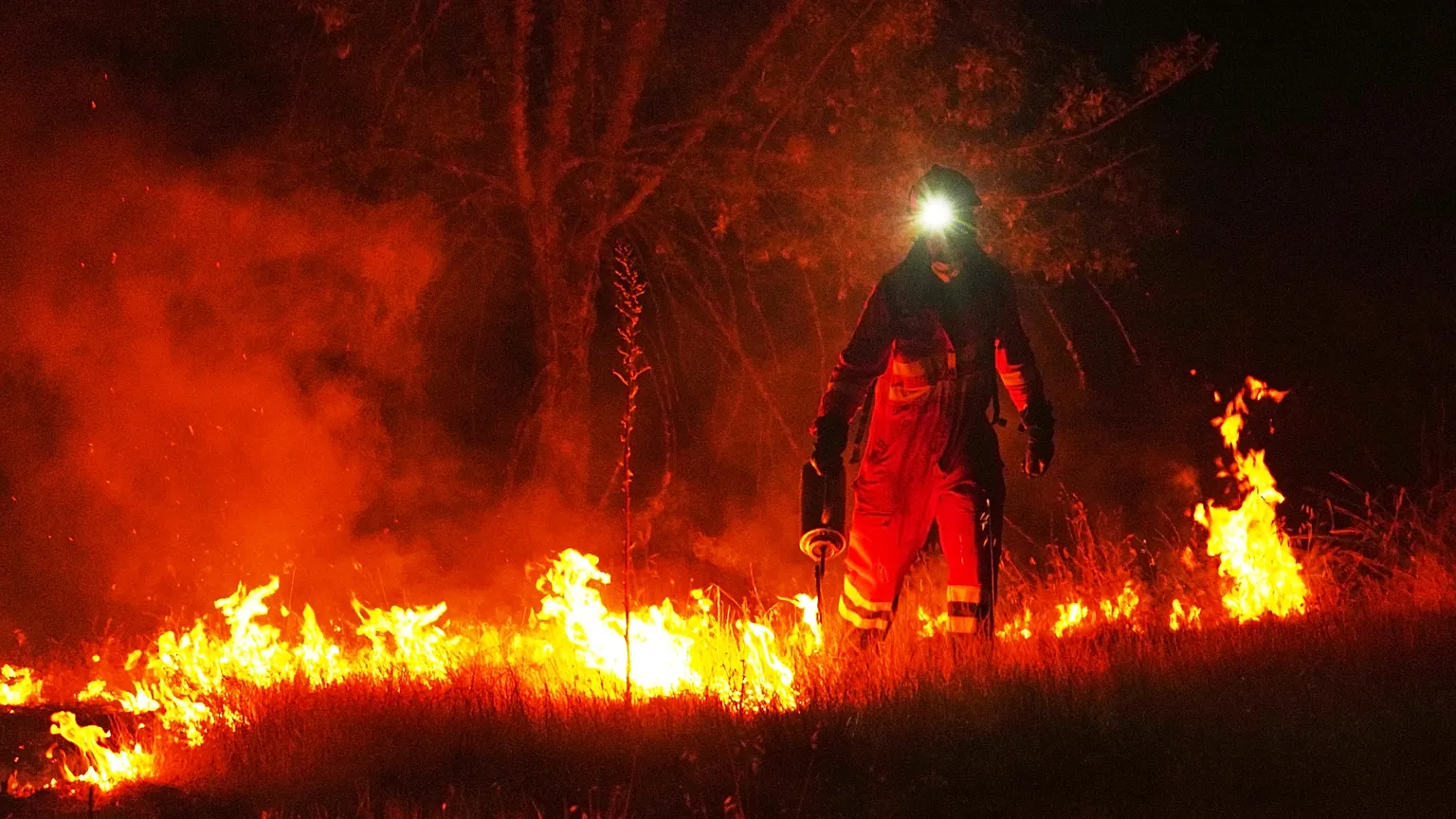
Record-breaking 2026 wildfires in France and Spain have forced over 330k evacuations near Bordeaux and Madrid. A new heatwave threatens to undo progress as climate emergency intensifies.
A punishing series of wildfires across southwestern Europe has forced more than 330,000 people to evacuate their homes and holiday destinations in France and Spain, as firefighters struggle to contain blazes before a new heatwave sends temperatures soaring past 40°C (104°F) later this week. The unprecedented crisis—Europe's worst wildfire season in modern history—has scorched hundreds of thousands of hectares, destroyed hundreds of homes, and prompted France to mobilize its military and Spain to declare its first national state of emergency.
France: Bordeaux Under Threat
In southwestern France, the main wildfire in the Gironde region has burned approximately 42,000 hectares (104,000 acres) and remains a significant threat to the city of Bordeaux, just 15 kilometers (9 miles) from the metropolitan area. Authorities have evacuated about 220,000 people from the region, including tens of thousands from Bordeaux's western suburbs and tourist areas along the Atlantic coast.
The fire's behavior has been extreme. The National Firefighters Federation of France reported that the blaze created a "pyrocumulonimbus"—a fire-induced thunderstorm capable of generating its own winds and lightning. "We don't know how the blaze will spread; the fire front is constantly shifting. We cannot fight it directly. It's a David-versus-Goliath scenario," said FNSPF spokesperson Eric Brocardi.
Firefighters have described the situation as "unprecedented," with 93 injuries reported as of Tuesday. French authorities have mobilized 1,500 soldiers and rushed out 1.5 million protective masks to shield residents from smoke inhalation. Nearly 4,000 additional evacuations were ordered from campsites and tourist residences around the resort of Lacanau as returning heat threatened firefighters' hold on the blaze.
Despite progress overnight, authorities described the Gironde fire as "stabilized, not fixed"—meaning it could still spread as temperatures rise . "We are at a point of fragility," Brocardi told BFMTV.
Spain: Largest Fire on Record
Spain is battling multiple fires, with the blaze in Ávila province west of Madrid now classified as the largest wildfire in the country's recent history. More than 500 square kilometers (190,000 acres) have burned in that fire alone—an area roughly the size of Barcelona.
Nearly 100,000 people have been evacuated in Spain, with the government declaring a national state of emergency for the first time over a wildfire . In the eastern province of Valencia, another fire forced the evacuation of approximately 15,000 people near the coastal city.
Interior Minister Fernando Grande-Marlaska described the situation as complex, with authorities expressing concern about the merging of multiple fire fronts into a single mega-blaze . "The coming hours will be absolutely decisive," he said.
Prime Minister Pedro Sánchez, visiting affected areas, described the fires as "the most painful expression of a climate emergency". He called for "a major public pact on the climate emergency".
International Response
Under the EU Civil Protection Mechanism, Greece and Italy have each sent Canadair water-bombing aircraft to Spain, with additional support from Portugal and Turkey. Switzerland is supporting France with two Super Puma helicopters, while Croatia, the Czech Republic, and Slovakia have also contributed aircraft.
European Commission President Ursula von der Leyen pledged ongoing assistance: "Europe stands with France and Spain in the face of the devastating fires affecting their territories".
Climate Drivers
The devastating fires are the culmination of a perfect storm of climate conditions. Western Europe recorded its hottest June on record, and the continent has experienced three successive heatwaves this summer. According to the EU's Copernicus Climate Change Service, much of western Europe experienced drier-than-average soil conditions in June 2026, creating tinderbox vegetation after earlier wet weather promoted rapid plant growth.
International scientific consortium "World Weather Attribution" warned on July 23 that Europe faces a compound drought crisis driven by both prolonged precipitation deficits and extreme heat. "We must act quickly to reduce greenhouse gas emissions, otherwise the frequency of hot and dry summers will continue to increase," said researcher Mariam Zakaria.
Historic Scale
The 2026 wildfire season is already rewriting record books. France has burned more than 116,000 hectares this year—already exceeding the previous record of 2022, with Prime Minister Sébastien Lecornu calling it an "unprecedented" season. Spain's 1,530 square kilometers burned so far represent six times the area scorched in the first half of 2025.
According to EFFIS data, the EU's Joint Research Centre, 2025 was the worst year for European wildfires on record since systematic satellite tracking began in 2006—a record that 2026 may surpass.
Industry and Economic Impact
Tourism and Agriculture
The wildfires have dealt a severe shock to regional economies heavily dependent on summer tourism. French Finance Minister Roland Lescure noted that the tourism-dependent economy of southwestern France has been particularly hard hit.
While prized Bordeaux vineyards have so far escaped direct fire damage, wine industry officials have identified drought—exacerbated by the same climate conditions—as the sector's primary concern. The fires have also disrupted transportation, with Spain's Madrid-Barcelona high-speed rail service temporarily suspended due to fire proximity.
Regional Vulnerability
Southern Europe bears a disproportionate burden of wildfire impact. EFFIS data indicates that Spain experienced 25 megafires (exceeding 10,000 hectares) between 2015-2025, while Portugal recorded 24 and Greece 8. These fires are increasingly affecting protected Natura 2000 sites, threatening biodiversity in areas designated for conservation.
What Happens Next
New Heatwave Approaches
The window of favorable weather for firefighters is closing rapidly. France's national weather service has forecast temperatures of up to 40°C from Tuesday, accompanied by dry winds that could increase fire risk. Spain is entering its fourth heatwave of the summer, with temperatures expected to exceed 40°C in many areas and reach 42°C in the northeast.
Future Outlook
Firefighters warn that full containment of the fires may require either heavy rainfall for several consecutive days or a significant shift in wind patterns. With neither forecast in the near term, the crisis is expected to continue.
European authorities have warned that this may be only the beginning of a challenging season. EU Crisis Management Commissioner Hadja Lahbib told the BBC: "Forecasters are predicting, unfortunately, another heatwave so we can expect other wildfires... we are expecting to face another historical, sad record because the season has started earlier in the year".
FAQ
What countries are affected by the 2026 Europe wildfires?
The most severe fires are burning in France and Spain, with significant impacts near Bordeaux, Madrid, and Valencia. Portugal, Italy, Greece, and other Mediterranean countries are also experiencing elevated fire risks .
How many people have been evacuated due to the 2026 Europe wildfires?
More than 330,000 people have been evacuated across France and Spain, with approximately 220,000 in France and nearly 100,000 in Spain .
Why are the 2026 wildfires so severe?
Three successive heatwaves and record-low rainfall have created tinderbox conditions across Western Europe. Scientists from World Weather Attribution link these conditions directly to climate change .
Is Bordeaux safe from the wildfires?
The wildfire is approximately 15km (9 miles) from Bordeaux's main metropolitan area. While the city itself has not been evacuated, western suburbs and surrounding communities have been evacuated .
How many hectares have burned in the 2026 European wildfires?
France has burned over 116,000 hectares in 2026, while Spain has seen approximately 153,000 hectares scorched. Combined, the two countries have lost land area roughly equivalent to 350,000 football fields .
How is the EU responding to the 2026 wildfires?
The EU has activated its Civil Protection Mechanism, deploying planes, helicopters, and ground personnel from multiple member states to support firefighting efforts in France and Spain .
KEY TAKEAWAYS
- More than 330,000 people have been evacuated from France and Spain as wildfires threaten Bordeaux and Madrid .
- France's Gironde fire has burned approximately 42,000 hectares—the country's largest wildfire since World War II .
- Spain's Ávila fire is the largest on record, scorching over 500 square kilometers (190,000 acres) .
- A new heatwave with temperatures up to 42°C threatens to reverse firefighting progress this week .
- The European Union has deployed a multi-country firefighting force including aircraft from Greece, Italy, Turkey, Croatia, and Switzerland .
- Scientists link the unprecedented fire season to climate-driven heatwaves and drought conditions .