
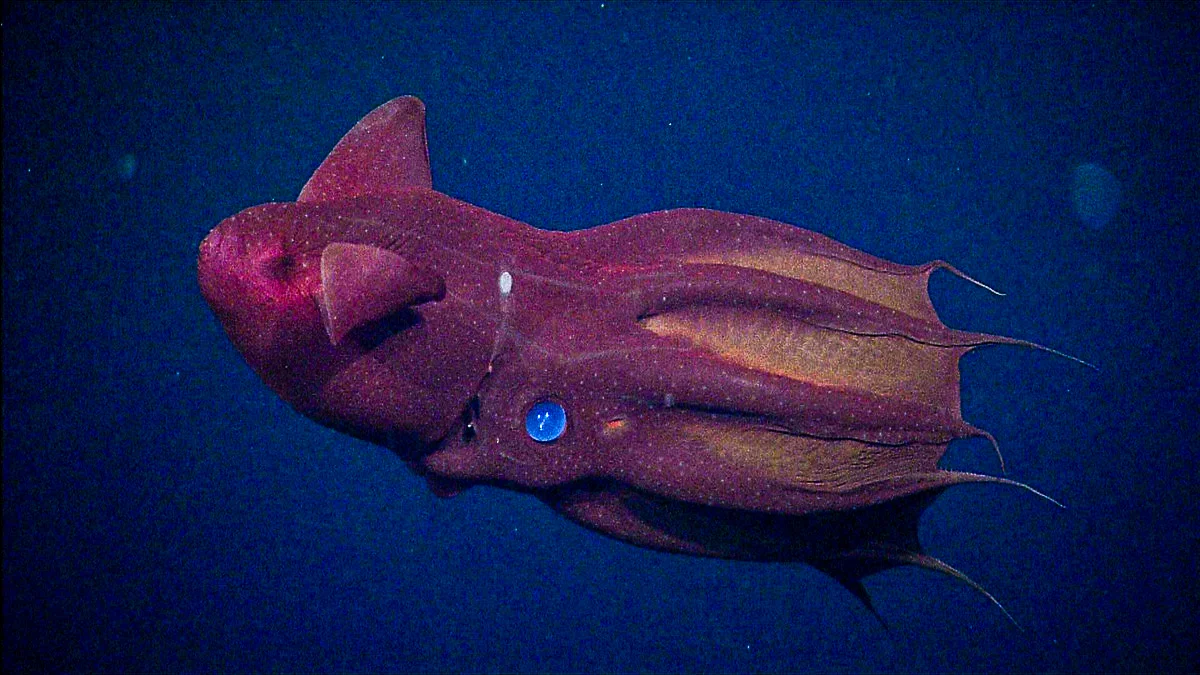
A vampire squid species announced in 2024 has been reclassified as the long-known Vampyroteuthis infernalis, after researchers found its distinguishing traits were normal variation.
In 2024, marine biologists announced something rare and remarkable: a second living species of vampire squid, plucked from deep waters in the South China Sea. Two years later, that species no longer exists in the scientific record as a distinct lineage. It turns out to have been the same animal science has known since 1898.
A lone survivor of an ancient order
The vampire squid, Vampyroteuthis infernalis, is a misfit in the cephalopod world. Despite its name, it is neither a true squid nor an octopus. It is the only known living member of an ancient order, Vampyromorphida, a lineage that dates back hundreds of millions of years.
German zoologist Carl Chun first described the animal at the turn of the 20th century, not in 1898 as originally published in some accounts, after specimens were hauled up during the SS Valdivia expedition. Chun's work helped demonstrate that complex life could survive far below the ocean surface.
The creature's appearance matches its dramatic name. Its eight arms are joined by a web of skin that can be spread like a cloak, or inverted over its body into a protective, spiny "pineapple" posture when threatened. It has large red or blue eyes and a dark body that can reach roughly a foot in length. It lacks ink sacs; instead, it defends itself by ejecting clouds of bioluminescent mucus from its arm tips.
Rather than hunting prey, the vampire squid feeds on "marine snow" — a drifting mix of dead plankton, mucus and other organic particles — which it collects using two retractable filaments. It lives in deep, oxygen-poor waters where most animals cannot survive.
The 2024 discovery
In September 2016, researchers from the South China Sea Institute of Oceanology collected a vampire squid between roughly 800 and 1,000 meters below the surface. The specimen looked different. Its mantle ended in a sharp point at the rear. Its lower beak appeared broader and more elongated than the historical description. Its photophores — the organs that emit light — sat midway between the fins and the tail, rather than in the upper third of the body as in known specimens.
The genetic data seemed to reinforce the case. Analyses of mitochondrial COI and nuclear rDNA sequences appeared to place the specimen in a distinct group relative to vampire squid samples taken from the Gulf of Mexico.
On that basis, the team described a new species in 2024 and named it Vampyroteuthis pseudoinfernalis. The announcement suggested that the ancient vampire squid lineage might be more diverse than anyone had assumed — and that the abyssal ocean could be hiding more of its living relatives.
The 2026 reversal
The claim did not convince everyone. A team of researchers, including Smithsonian cephalopod expert Michael Vecchione, re-examined the evidence. They looked at a broader collection of vampire squid specimens and analyzed additional genetic markers.
The reanalysis found that the supposedly unique traits were not diagnostic at all. The shape of the lower beak wings and the spacing of the photophores varied considerably across vampire squids depending on the stage of their life cycle. What had looked like species-level differences fell within the normal range of individual variation.
The researchers also flagged a persistent problem in deep-sea biology: soft-bodied animals can be deformed when they are hauled from high-pressure depths to the surface, distorting the very features scientists use to identify them.
Crucially, the expanded genetic dataset did not support a separate lineage. The differences between the South China Sea specimen and vampire squids from other regions were not enough to justify a new species. The team's conclusion, published in the Bulletin of Marine Science, was that V. pseudoinfernalis is a junior synonym of V. infernalis.
What the correction shows
The name has not been erased. It remains in the record as a junior synonym — a designation that points back to a species that already had a valid name. That is how taxonomy is supposed to work: a living record that gets revised as evidence accumulates, not a fixed ledger.
The episode is a reminder of a recurring hazard in deep-sea research, where new species are sometimes described from single specimens. A creature collected once, under enormous pressure and physical stress, can present features that look distinctive and later prove ordinary.
For now, the vampire squid retains its unusual status: the only known living member of Vampyromorphida, a lineage with no close surviving company. Whether a genuine second species exists somewhere in the deep ocean remains an open question — one that will require more than a single specimen to answer.