
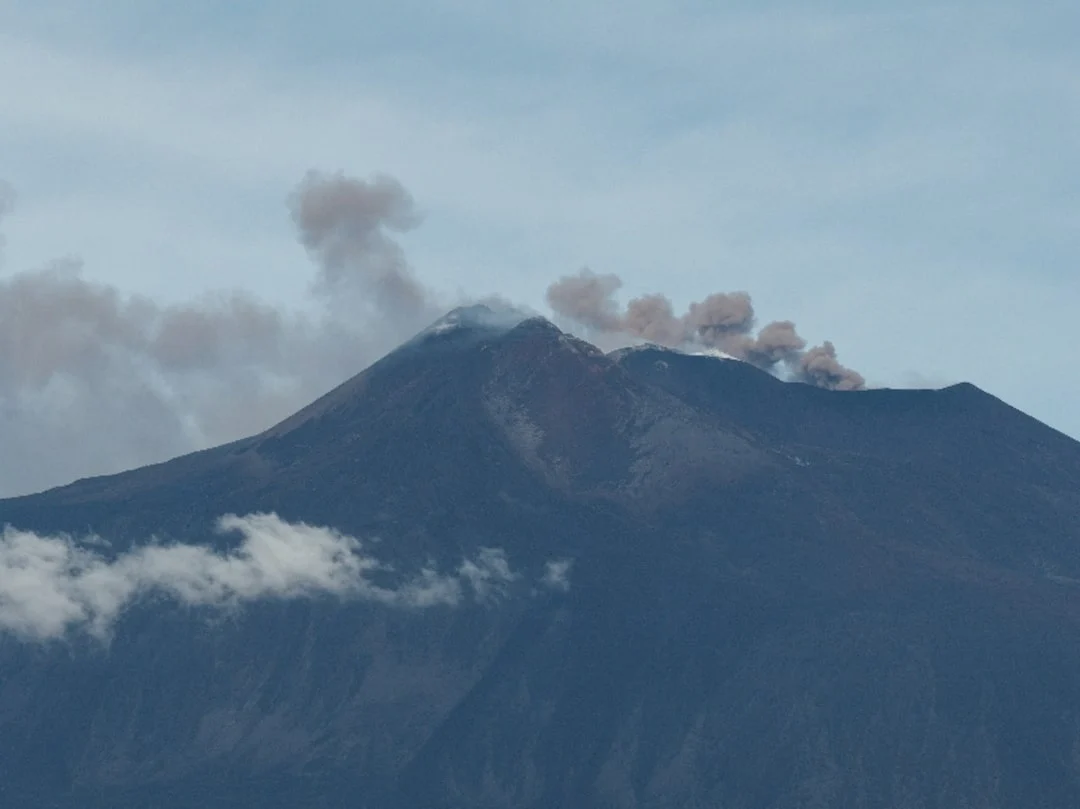
Mount Etna's unusually prolonged eruption has repeatedly shut Catania airport through summer and autumn 2026, disrupting thousands of travellers as ash plumes drift over Sicily.
Mount Etna, Europe's highest and most active volcano, has sustained an unusually long eruptive phase through the summer and into the autumn, repeatedly forcing the closure of Catania's airport and disrupting travel across eastern Sicily.
The most recent disruption ended on Monday, September 28, when airport operator SAC said ordinary operations had resumed after a three-day stoppage. Flights had been suspended from Saturday because of volcanic ash. It was the latest in a series of closures that have hit the Sicilian hub, Italy's fifth-busiest by passenger traffic, throughout the season.
A Durability That Stands Out
Etna erupts often, but the length of the current activity is what has drawn attention. In August, the eruption ran for seven consecutive days, with the airport extending flight suspensions as the ash plume persisted.
Salvo Gambino, director of the Etnean Observatory in Catania at Italy's National Institute of Geophysics and Volcanology (INGV), told Euronews that comparable activity had last been seen in the late 1970s. More recently, lava fountains and flows "generally lasted for a very limited time, from a few hours to half a day," he said. "In this case we have seven days of continuous activity, which is a distinctive feature of the current eruption."
Gambino suggested the persistence may reflect "magma rising from greater depth and richer in gas."
The Plume, Not the Lava, Is the Problem
The eruption is affecting several parts of the volcano at once. At the Voragine crater, lava fountains continue alongside a steady emission of ash, while vents in the Valle del Bove are feeding a lava field. Gambino said the flows do not currently threaten inhabited areas.
The disruption instead comes from the ash cloud. Southerly winds have pushed the plume toward Catania airport and beyond Sicily. "The biggest problem at the moment is mainly linked to the continuous plume coming from the Voragine," Gambino said, noting that winds blowing toward the south have carried the cloud over the airport area.
Italy's civil protection minister, Nello Musumeci, argued in August that the vulnerability lies with the airport's location rather than the volcano itself. "It is not the volcano that is out of place, but the airport," he said, referring to Catania's proximity to the mountain.
Tourists Flock to the Slopes
The spectacle has drawn large crowds to Etna, nicknamed "Her Majesty" by locals, creating congestion on the roads and paths used to view the activity. "There are too many people and too many cars parked in a chaotic way," nature guide Cristian Alessi told Euronews.
As of September 27, the Global Disaster Alert and Coordination System (GDACS), a framework run by the United Nations and the European Commission, rated the eruption at overall Green, indicating a low expected humanitarian impact.
What to Watch
Etna's pattern makes forecasting difficult. The current phase has combined sustained activity with favourable wind directions that repeatedly funnel ash toward a busy airport, producing disruption disproportionate to the eruption's physical scale. Whether the airport closures continue into the autumn will depend largely on how long the Voragine plume persists and which way the wind blows.
Sources: Reuters, Euronews, GDACS.