
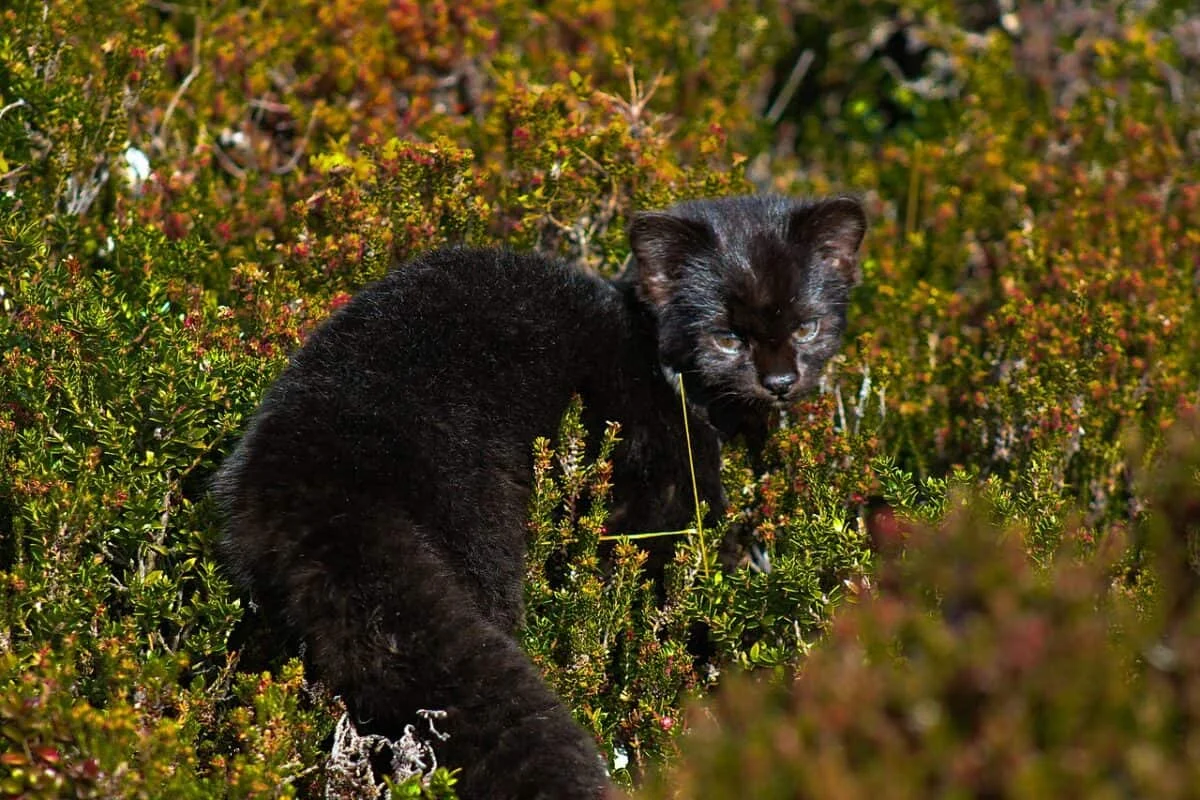
A rare melanistic kodkod, the smallest wild cat in the Americas, has gone viral. But its IUCN downlisting reflects better data, not recovery — and three subpopulations remain at risk.
Images of a jet-black wild cat emerging from the forests of southern South America have circulated widely in recent months, drawing fresh attention to the güiña (Leopardus guigna) — better known internationally as the kodkod, the smallest wild cat in the Americas.
The animal in the widely shared photographs is melanistic, meaning an excess of dark pigment has overtaken its normal coat. Melanism is rare across cat species and is more commonly associated with jaguars and leopards. Even under its dark fur, the güiña's rosettes and tail rings can still be discerned in the right light.
A cat the size of a house cat
The güiña is genuinely small: roughly 37 to 51 centimetres (15 to 20 inches) in head-and-body length, with a weight averaging around 2 to 3 kilograms (4.4 to 6.6 pounds). The name kodkod derives from an Araucanian word; local communities in its range generally call it the güiña.
It is native to central and southern Chile and adjacent parts of Argentina, where it hunts rodents, birds, reptiles and frogs. Like most small cats, it is solitary, largely nocturnal and highly secretive — which is why sightings in the wild are uncommon, and photographing one with melanism rarer still.
The status question
The viral images arrive against a more consequential and less photogenic development: in October 2025, the International Union for Conservation of Nature reclassified the güiña from vulnerable to least concern on its Red List of Threatened Species.
That shift might read as a straightforward conservation win. The researchers behind the assessment say it is not.
"It's not that the species is doing better, it's that we have better information," Nicolas Galvez, who led the IUCN assessment and is an associate professor at the Pontifical Catholic University of Chile, told Mongabay. The new data included a higher population estimate and evidence that güiña can persist in some altered agricultural landscapes, not only native forest.
Three of the six recognised subpopulations — in Argentina and in central and northern Chile — remain at high risk of local extinction, according to the assessment team. Threats include habitat loss, human-wildlife conflict, disease contracted from domestic dogs and cats, climate change and increasingly severe forest fires.
Funding fear
Conservationists have warned that the downgrade could be misread as a signal that the species no longer needs support. "Reclassifying species to a lower threatened status gives the impression that these particular species are doing well and therefore need … less conservation attention," Wai-Ming Wong, director of small cat conservation science at the NGO Panthera, told Mongabay. "To divert conservation resources away from that particular species just because it's being reclassified, I think wouldn't be the best thing to do."
The güiña's ecological role is often understated. By preying on rodents, it helps regulate populations of the long-tailed colilargo, the main vector of hantavirus — a detail with direct implications for the forestry and agricultural workers who account for most fatal human cases, Galvez noted.
What the images do and don't show
Viral wildlife photographs tend to flatten a species into a single striking image. In the güiña's case, that image is a rare black cat. The fuller picture is of a small predator that is abundant in parts of southern Chile and imperilled elsewhere, whose global listing improved largely because scientists now know more about it — not because the pressures on it have eased.
Both things are true at once, and the second is the one that will determine whether the cat continues to be seen at all.