
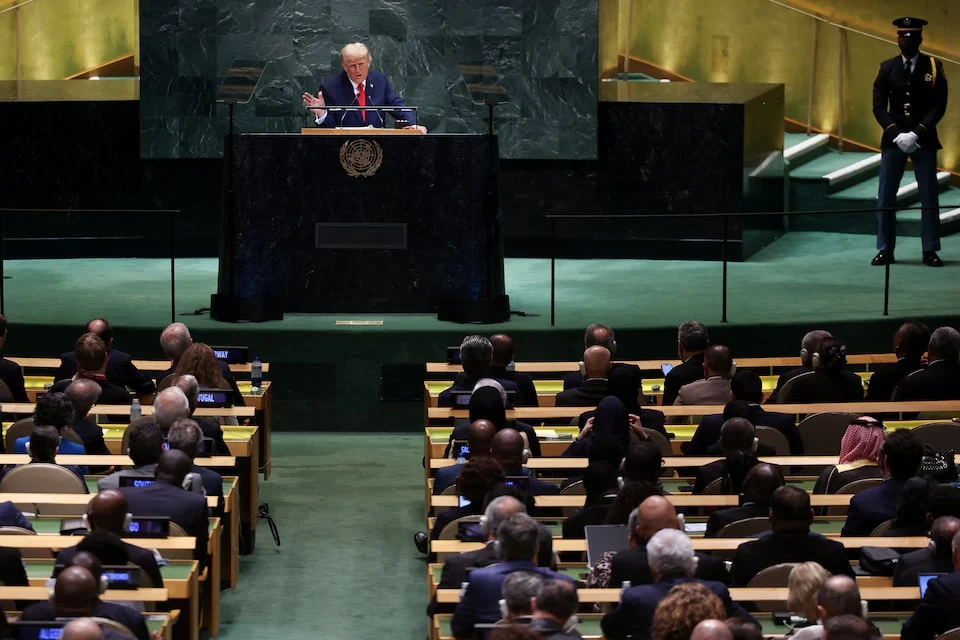
President Trump told the UN General Assembly he faces a 'big decision' on the Iran war — annihilate the Islamic Republic or strike a deal — as US envoys met Iranian mediators for three hours.
President Donald Trump told the United Nations General Assembly on Tuesday that he faces a "big decision" on the nearly seven-month war with Iran — pursue a negotiated settlement or "annihilate" the Islamic Republic — as his envoys held a three-hour meeting with Iranian mediators on the sidelines of the gathering.
"Will a deal be made with Iran that lets them rebuild and create a far greater country than it ever was before?" Trump asked in a 37-minute address. "Or do I annihilate the Islamic Republic and do it quickly, never giving them a chance to kill and destroy people and countries again? Do I drive them into hell?"
A single member of Iran's delegation watched from the floor as Trump spoke before a standing-room-only chamber.
Talks on the sidelines
Speaking to reporters afterward, Trump initially said U.S. and Iranian officials had held a "very productive" three-hour meeting, then appeared to clarify that his envoys, Steve Witkoff and Jared Kushner, had met with mediators rather than Iranian officials directly.
"Steve and Jared had a very productive meeting today with mediators of Iran, merely mediators," he said. "Let's see what happens with that."
Iranian state television confirmed that Foreign Minister Abbas Araghchi had met Witkoff. Witkoff later said the talks were conducted "through the mediators, who shuttled between the two sides throughout the day," describing a completed round of discussions that he hoped would prove "constructive and promising."
Trump predicted a deal would come after the U.S. midterm elections on November 3, and called on other nations to join Washington in isolating Iran economically to force it to the negotiating table. The war, launched by the U.S. and Israel in February, has driven up global oil prices and weighed on Trump's approval ratings.
A speech aimed beyond the chamber
Trump opened by touting his record on the economy, immigration, the border and violent crime — remarks that sounded directed more at American voters than at the diplomats in Manhattan. He argued the Iran conflict had prevented Tehran from obtaining a nuclear weapon, framing it as evidence of "peace through strength."
His tone contrasted sharply with that of UN Secretary-General António Guterres, who in a farewell address warned that global divisions were deepening. "The fault lines in our world are widening," Guterres said, citing geopolitical rivalries, wars, climate change and artificial intelligence.
Trump attacked the UN itself, accusing it of a "far-left agenda of globalist bureaucrats who nobody ever elected," and declared: "There is no global government." He singled out the International Criminal Court, saying U.S. service members would never be subject to its authority.
His appearance came less than a week after a UN fact-finding mission said it had reasonable grounds to believe U.S. forces committed war crimes in two strikes on Iran, including one that hit a primary school in the southern city of Minab.
Greenland, Ukraine and a walkout
On the sidelines, Trump signed an agreement with the leaders of Denmark and Greenland to expand the U.S. military presence on the North Atlantic island. The deal reaffirms Greenland's sovereignty as an autonomous Danish territory but grants the U.S. broad access to its airspace and territory.
He also predicted his diplomacy would end Russia's war in Ukraine, saying, "We're working very closely with the leaders of Russia and Ukraine, and we will get that one done." Secretary of State Marco Rubio is due to meet Russian Foreign Minister Sergei Lavrov in New York on Wednesday.
Trump met more than a dozen world leaders during the day, including Ukrainian President Volodymyr Zelensky, British Prime Minister Andy Burnham — their first face-to-face meeting — and Japanese Prime Minister Sanae Takaichi. He is due to meet Chinese President Xi Jinping in Washington later this week.
Trump also used the speech to attack Cuba, calling it an "absolutely failed state" and accusing its government of cultivating ties to left-wing groups in the U.S. The Cuban delegation walked out of the chamber as he spoke.
On artificial intelligence, Trump dismissed fears about the technology and said the U.S. would not surrender its lead to China. "The use of the word artificial makes it sound fake," he said, suggesting it be renamed "super intelligence."