
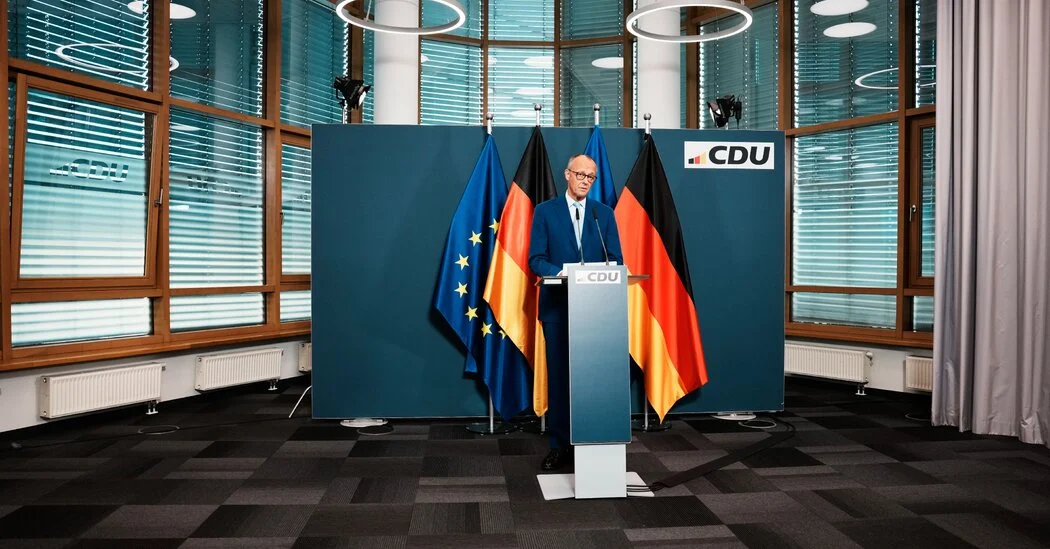
Chancellor Friedrich Merz vows to stay on and press ahead with reforms after the CDU recorded its worst state election result since WWII and the far-right AfD won Mecklenburg-Western Pomerania.
German Chancellor Friedrich Merz said on Sunday he would remain in office and press ahead with his reform agenda, after his Christian Democratic Union (CDU) suffered its worst state election result since World War II and the far-right Alternative for Germany (AfD) extended a run of strong showings.
Projections by public broadcaster ARD put the CDU at just 4.9% in the northeastern state of Mecklenburg-Western Pomerania — below the 5% threshold needed to enter the state parliament. If the figure holds in the final count, the party would fail to win seats in a state legislature for the first time in its history. Merz called the outcome a "disaster."
In the capital, Berlin, projections showed the CDU second with 19.1%, behind the far-left Die Linke at 25.3%, according to ARD. Die Linke's candidate, Elif Eralp, would become the capital's first leader of Turkish origin if the result is confirmed.
AfD Doubles Its Share
The anti-immigration, Kremlin-friendly AfD came first in Mecklenburg-Western Pomerania with roughly 38%, more than doubling its previous score, and took 16.2% in Berlin. It was the third time the party has finished as the strongest force in a regional vote.
AfD co-leader Tino Chrupalla called on Merz to resign. National co-leader Alice Weidel told ZDF that the party had "displaced the CDU as the people's party."
The AfD is likely to remain shut out of government in Mecklenburg-Western Pomerania, however, because the other major parties maintain a "firewall" of non-cooperation with the far right. The state's Social Democratic premier, Manuela Schwesig, was expected to hold on to power in a left-leaning coalition despite finishing second.
A Defiant Merz
Speaking in a rare state election-night address, Merz, 70, acknowledged that his party had been denied "tailwinds from Berlin" but rejected any retreat from reforms covering taxes, healthcare, pensions and bureaucracy.
"What needs to be done now requires backbone, steadfastness and patience," he said, pledging to demonstrate those qualities as CDU chairman and as chancellor.
Merz framed the stakes in stark terms, describing his reform drive as "the antidote to the poison of authoritarianism, which is penetrating ever deeper into our society as the fascination with authoritarianism grows." He said trust in Germany's institutions was "waning and is being actively undermined by radical parties on both the left and the right."
Pressure on Europe's Largest Economy
Merz took office in May 2025 at the head of a coalition with the centre-left Social Democrats, promising to revive Germany's economy and cut the AfD's support. Roughly 16 months later, only about one in 10 Germans say they are satisfied with his performance, according to polling cited by The Guardian.
The result in Mecklenburg-Western Pomerania was especially bitter for Merz: the small, relatively poor state was home to the constituency of his predecessor and long-time rival, Angela Merkel, who governed for 16 years.
The outcome adds to a sense of instability in Europe's largest economy, which is contending with deindustrialisation, sluggish growth and high energy costs. The AfD, now the largest opposition force in the national parliament, leads national opinion polls at around 30%.
The results will also be read across Europe, where nativist parties are advancing ahead of elections in France, Italy, Spain and Poland next year. The AfD has called for Germany to leave the euro, end support for Ukraine and carry out mass deportations of irregular migrants.