
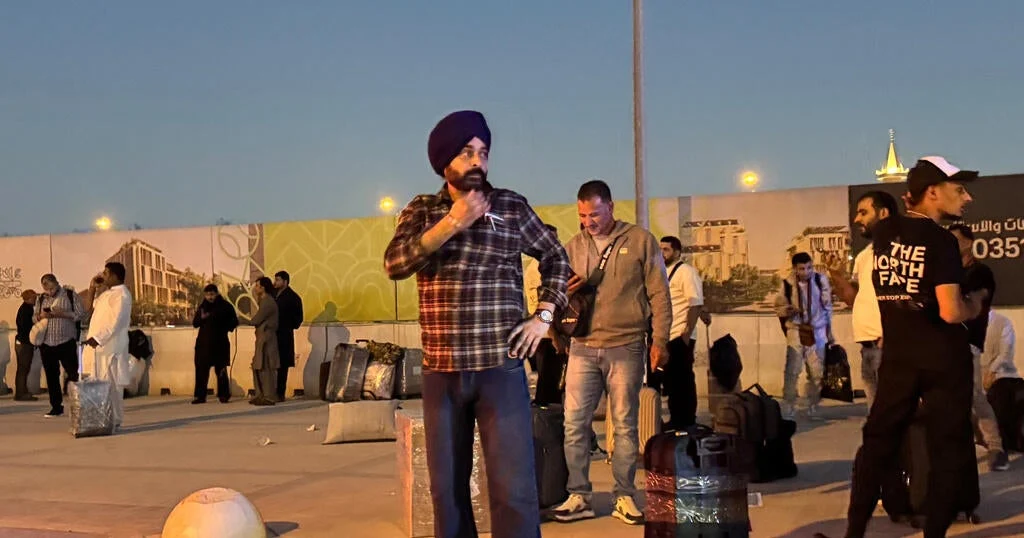
Saudi Arabia vows a decisive response after Houthi strikes on Riyadh's King Khalid International Airport killed at least 12 and wounded over 300, with the airport hit again Sunday.
Saudi Arabia has promised a "decisive" response after a missile attack on Riyadh's King Khalid International Airport killed at least 12 people and wounded more than 300, the deadliest strike on Saudi soil in over a decade. The airport was hit again on Sunday, as Yemen's Iran-backed Houthi movement threatened further attacks on the kingdom's airports and oil infrastructure.
A widening assault on the kingdom
The initial strike on Saturday killed 12 people and injured 309, some critically, according to the Saudi General Authority of Civil Aviation. The dead included four Saudi nationals, two Bangladeshi nationals and one citizen each from the United States, Egypt, Jordan, Syria, Palestine and Sudan. An Indian national who was wounded later died, India's embassy in Riyadh said Sunday.
A passenger terminal at the airport was struck again on Sunday, injuring people at Terminals 3 and 4, which serve domestic flights. Houthi military spokesman Brig. Gen. Yahya Saree said on Telegram that the group has carried out at least four operations targeting the airport since Saturday, describing them as a response to what he called "brutal Saudi aggression." He said Saudi Arabia had launched more than 120 airstrikes in Houthi-controlled territory in Yemen over 24 hours.
The Houthis said they also targeted the Shugadam gas facility, owned by state oil company Aramco, the Tanajib refinery, and King Fahd International Airport in Dammam. Saudi aviation authorities confirmed the Dammam strike. In a separate statement, the Houthis said an airport under their control in Yemen's capital, Sanaa, had also been struck, which they blamed on Saudi forces.
Airport closed, schools moved online
King Khalid International Airport — struck four times in five days — has been closed since Saturday's attack, with flights diverted elsewhere, according to the Flightradar24 tracking service. Riyadh has moved its schools online. The United States, Britain, Germany, Australia and Canada have warned citizens to avoid the airport.
The Houthis had earlier threatened new strikes on the kingdom's airports, exempting only the holy sites of Mecca and Medina, and warned passengers not to travel. "The airports and airspace are exposed to targeting and constitute a theatre of operations for our forces," Saree wrote on X.
International reaction and a U.S. decision
The attack drew condemnation from the United Nations and world leaders. President Donald Trump said he was considering joining Saudi strikes on the Houthis. Secretary of State Marco Rubio said the United States "strongly condemns" the attacks, including the strike that killed an American citizen. European Commission President Ursula von der Leyen warned that the attacks by Iran's proxies are "pushing the region into a spiral of violence" and "destabilizing crucial global transport and energy nodes." Israeli Prime Minister Benjamin Netanyahu condemned the attack "in the strongest possible terms."
The escalation has further complicated stalled efforts to halt the broader U.S.-Iran war. The surge in Houthi attacks follows a major Saudi-led coalition offensive against the group launched in the past week. King Khalid International Airport has no military facilities.