
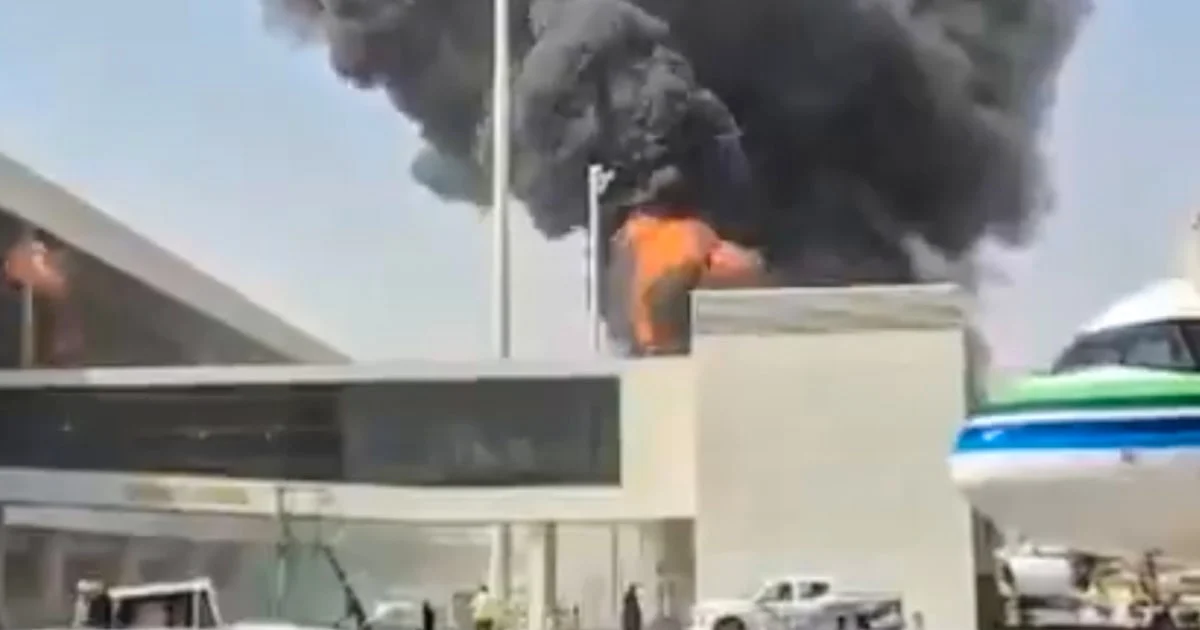
A Houthi missile strike on Riyadh's King Khalid International Airport killed 12 people and injured over 300, the deadliest attack on a Gulf state since the Iran war began, as President Trump weighs whether the U.S. should join Saudi strikes against the rebels.
RIYADH, Saudi Arabia — A missile strike on Riyadh's King Khalid International Airport killed 12 people and injured more than 300, Saudi civil aviation authorities said early Sunday, in the deadliest attack on a Gulf Arab state since the start of the Iran war. A Saudi-led coalition blamed Iran-backed Houthi rebels in neighboring Yemen.
The strike, the third on the airport in a week, hit a complex housing terminals 3 and 4 for domestic flights, according to a regional official who spoke on condition of anonymity because he was not authorized to brief the media. Saudi authorities said some of the injured were in critical condition and were being treated at several hospitals.
Among the dead were four Saudi citizens, two Bangladeshi nationals, and one each from the United States, Egypt, Jordan, Syria, Sudan and the Palestinian territories. U.S. Secretary of State Marco Rubio confirmed an American citizen was killed, calling the attacks "reprehensible" and saying they "must stop now."
Trump Weighs Joining Saudi Strikes
Shortly after the attack, U.S. President Donald Trump said he was evaluating whether Washington should join Saudi strikes against the Houthis. "We may. We're going to look at it," he said. "We just found out about the recent attack. So we'll make a decision. We move very quickly."
Trump later said he planned to speak with Crown Prince Mohammed bin Salman and described the attack as "not acceptable." Asked whether the U.S. might intervene, he replied, "We'll find out."
The Saudi-led coalition called the strike a "fully-fledged war crime" and vowed a firm response, noting the airport has no military facilities. There was no immediate claim of responsibility from the Houthis, who earlier Saturday accused Saudi Arabia of striking Sana'a International Airport in the Houthi-held Yemeni capital.
Escalation Along the Red Sea
The attack is the bloodiest in any Gulf Arab country since the Iran war began and reflects a widening front. The Houthis had largely stayed on the sidelines until recently; their renewed campaign gives Tehran a means of pressuring a key U.S. ally. The U.S. bombing campaign that had sharply limited Houthi attacks on shipping has not halted the rebels' strikes on Saudi territory.
The escalation follows the collapse in July of a truce that had held since 2022. Fighting has intensified as the Saudi-led coalition provides air support to Yemeni government forces trying to reverse recent Houthi gains along the Red Sea — gains that gave the rebels better surveillance of a shipping corridor seen as a crucial alternative to the Strait of Hormuz.
On Saturday, forces allied with Yemen's UN-recognized government said they had retaken the Bab al-Mandab strait from the Houthis, though accounts differed on whether the offensive had succeeded. A Houthi spokesperson said government forces were targeted with ballistic missiles and heavy weapons, resulting in the destruction of more than 22 armored vehicles. The Saudi ambassador to Yemen, Mohammed al-Jaber, said the strait had been "cleared of the remnants of the Houthi terrorist militia." The UN's special envoy to Yemen, Hans Grundberg, told the Security Council that the country had lapsed back into full-scale war.
Aviation Disrupted, Defenses Strained
Saudi civil aviation authorities said airport operations were suspended. Entrances were blocked, lights around the complex were dimmed, and flights were diverted, according to the Flightradar24 tracker. The United States, Britain, Germany, Australia and Canada warned citizens to avoid the airport. Airlines including Air India, FlyDubai, Lufthansa Group and Pakistan International Airlines have suspended flights to and from Saudi airports for varying periods.
The European Union Aviation Safety Agency expanded its guidance on Saudi airspace, citing the Houthis' ability to strike deeper inside the kingdom and a "greater focus on aviation infrastructure," warning that missile and interception activity "create an increased risk of misidentification of civil aircraft."
Saudi Arabia is running low on missile interceptors and has asked France, Britain, Pakistan and Egypt to deploy air defense support to the region, regional officials said, as the U.S. has seen its own stockpile dwindle during the war with Iran. Officials said U.S. assistance has included intelligence sharing, target identification and planning for the latest offensive against the Houthis.
Also Saturday, U.S. Central Command said a fighter jet struck and disabled a commercial cargo vessel with a precision munition in the Gulf of Oman as part of a naval blockade of Iranian ports. The Panama-flagged M/V Ocean Molica had departed an Iranian port and did not heed repeated warnings; its crew was unharmed, CENTCOM said.
Despite the attacks, Saudi Arabia's energy ministry continued to promote a major international energy conference set to begin in Riyadh on Sunday.