
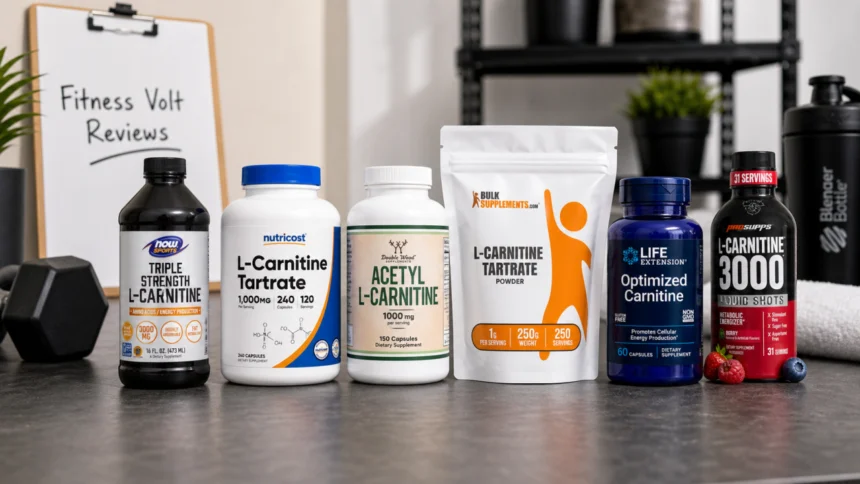
Clinical trials on L-carnitine show mixed results for training, and there is little direct evidence that combining it with caffeine boosts performance or fat burning.
L-carnitine is one of the most heavily marketed ingredients in sports supplements and energy drinks. It is also one of the most contested. A review of the available clinical research shows a supplement with a plausible biological mechanism, mixed and often modest results in controlled trials, and — notably — almost no direct evidence that combining it with caffeine delivers the synergistic boost that product labels imply.
What L-carnitine does — and the absorption problem
L-carnitine is a compound the body produces in the liver, kidneys and brain. Its established physiological role is to shuttle long-chain fatty acids into the mitochondria, where they are oxidised for energy. That mechanism is the basis for its marketing as a fat-burning and endurance aid.
The central limitation is bioavailability. As researchers have documented, less than 20% of an oral L-carnitine supplement is absorbed by the human body. The remaining 80% travels to the colon, where gut microbes metabolise it into trimethylamine (TMA), which the liver then converts into trimethylamine N-oxide (TMAO). Elevated TMAO levels have been linked to cardiovascular disease in observational and mechanistic research, including work from the Cleveland Clinic showing increased thrombosis risk from a related nutrient.
This does not make L-carnitine intrinsically harmful. When produced by the body it is not metabolised by gut microbiota into TMAO, and it is absorbed more efficiently from meat than from supplements. But it does mean oral dosing is inefficient and carries a metabolic side pathway that supplement labels rarely mention.
Mixed results in controlled trials
The clinical record is inconsistent. A four-week randomised controlled trial in 41 trained male cyclists found that L-carnitine combined with alpha-lipoic acid did not improve cycling performance. A 2021 systematic review and meta-analysis in Clinical Nutrition ESPEN examining weight loss and body composition opened by noting that clinical evidence had been inconsistent; its pooled results did not clearly support the fat-loss claims used in marketing.
More encouraging signals appear elsewhere. An eight-week study of 218 Romanian recreational gym-goers, published in Sports in 2025, found that L-carnitine was associated with a decrease in body weight — unlike creatine and whey protein, which were linked to weight increases — and that L-carnitine produced the second-greatest improvement in resistance-training performance, behind only a combination of all three supplements. In women, the researchers reported that L-carnitine supplementation produced a notable performance improvement compared with the control group.
That study was observational in its supplement grouping rather than a tightly controlled dosing trial, so its results should be read as suggestive rather than definitive. Ongoing registered research, such as a trial examining L-carnitine and recovery after high-intensity interval exercise in young athletes, is still recruiting, meaning key questions remain open.
The caffeine question
Caffeine is among the best-established ergogenic aids in sports science, with performance effects generally in the range of 2–5% for responsive individuals. Because of that strong evidence base, caffeine is frequently paired with L-carnitine in pre-workout and thermogenic products, with marketing implying an additive or synergistic fat-burning effect.
Direct evidence for that combination is scarce. Searches of the clinical literature return extensive research on caffeine with other compounds — L-theanine, taurine, carbohydrate — but no robust body of controlled trials isolating a caffeine-plus-L-carnitine effect on training performance or fat oxidation. Where L-carnitine is studied alongside caffeine, it is typically as one of several ingredients in a multi-ingredient fat-burner formula, which makes it impossible to attribute any observed effect to the combination itself.
In short, the caffeine-plus-L-carnitine claim rests largely on mechanism and marketing rather than on trials designed to test it. The performance benefit that users may experience from such products is most plausibly explained by the caffeine.
What this means for people who train
Three points follow from the evidence:
- Caffeine is the reliable component. Its ergogenic effects are well supported across many exercise modes and populations. If a pre-workout product works for you, caffeine is the most likely reason.
- L-carnitine has a plausible role but weak oral absorption. Any benefit from supplementation is likely to be modest and inconsistent, and higher doses increase the amount converted to TMAO in the gut.
- Pairing it with polyphenol-rich foods may reduce the risk pathway. Laboratory work at the Quadram Institute found that pomegranate extract — rich in ellagitannins, also found in raspberries and walnuts — reduced microbial TMA production when gut microbes were exposed to L-carnitine. Human trials testing this are now under way.
The honest summary for athletes is that L-carnitine is not a proven performance enhancer on the strength of current evidence, and the specific caffeine-plus-L-carnitine combination that dominates supplement shelves has not been validated in controlled human trials. Buyers should weigh the marketing against a thinner evidence base than the packaging suggests.