
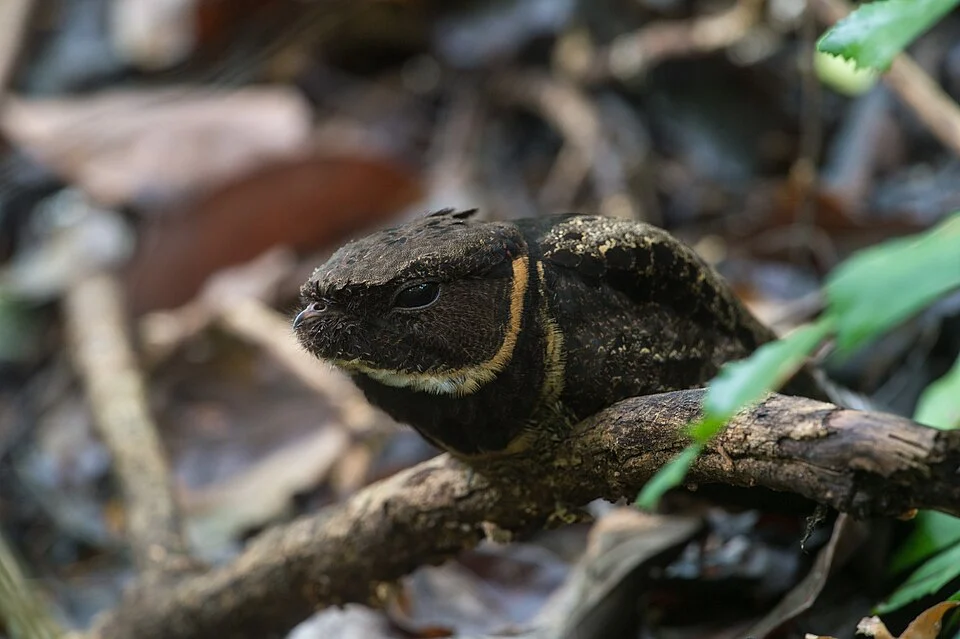
The great eared nightjar is the largest nightjar species, a nocturnal hunter that lays a single camouflaged egg on the forest floor. A recent sighting in Thailand after 30 years has renewed attention on the 'dragon bird'.
Most people encounter the great eared nightjar as a photograph and assume it has been edited. The bird's elongated ear tufts, oversized dark eyes and downturned "chin" give it the silhouette of a small dragon, and the images circulate online precisely because the face looks implausible. The species is real, and its appearance is not decoration. It is a survival design.
What the bird actually is
The great eared nightjar (Lyncornis macrotis) is a member of the nightjar family, Caprimulgidae. At 31 to 41 centimetres in length, it is the largest nightjar species by length, and at roughly 131 grams for males and 151 grams for females it is among the heaviest. It is found across subtropical forests and lowlands in South and Southeast Asia, including Thailand, Vietnam, India, Myanmar, Malaysia, Bangladesh and Sri Lanka. The IUCN lists it as a species of Least Concern.
Camouflage is the point
The plumage is a mottled mix of brown, grey and black that mimics bark and dried leaves. A nightjar resting on a fallen branch can be effectively invisible, and the birds often hold still rather than flush when a human approaches. The ear tufts, which resemble horns or lynx ears, can be moved back and forth. They are not ears; the bird's actual hearing is not located there.
It hunts on the wing, at night
Great eared nightjars are nocturnal. They emerge at dusk and hunt flying insects — moths and beetles in particular — using a wide, scoop-shaped mouth and strong night vision. They glide more than they flap while hunting, which keeps them quiet and lets them take prey that never detects the approach. Unlike some nightjars, they do not have the rictal bristles around the beak that help other species detect prey by touch, which makes their large eyes and aerial agility all the more central to how they feed.
No nest, just the ground
The species does not build a nest. A single egg is laid directly on the ground or on a pile of leaves, and its markings blend into the litter around it. Both parents share incubation and care of the chick. The strategy is camouflage rather than defence: if a threat approaches, the adult is more likely to freeze than fly. The call is a series of croaks and growls that carry through the trees, so the bird is often heard and almost never seen.
Why it is back in the news
In April 2026, a great eared nightjar was spotted at Ban Krang Camp in Thailand's Kaeng Krachan National Park — the first sighting there in around 30 years, according to Khaosod English and other Thai outlets. The bird perched openly on a branch near the roadside, and images shared on social media drew hundreds of wildlife photographers and tourists to the park during the Songkran holiday. It is the largest nightjar species in Thailand.
The sighting is a useful reminder of how little is known about a bird that is not, on paper, rare. Great eared nightjars are difficult to survey because they are nocturnal, superbly camouflaged and largely silent when they choose to be. A species listed as Least Concern can still go three decades without being confirmed in a well-studied national park. Whether the Kaeng Krachan bird reflects a recovering local population, a wandering individual or simply an animal that was always there and finally decided to sit in the open is not something the evidence settles. For now, the most reliable conclusion is the one the photographs support: the dragon-bird is real, and it is very good at not being found.