
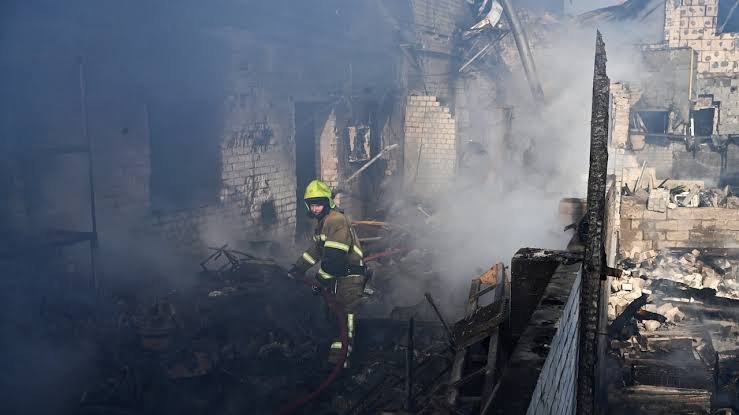
Russian airstrikes hit Kyiv and the surrounding region for a sixth day, killing four and injuring 14 as Ukraine faces sustained aerial attacks.
Russia strikes Kyiv region for sixth straight day, killing four
Russian airstrikes killed four people and injured 14 in Kyiv and the surrounding Kyiv region on Tuesday, September 1, according to Ukrainian local authorities, as Russia continued a sixth consecutive day of attacks on the Ukrainian capital and nearby communities. The latest strikes underscore the sustained pressure on Ukraine’s air defenses and civilian infrastructure while diplomatic efforts involving the United States and Ukraine remain active.
Explosions were heard across Kyiv early Tuesday, according to a Reuters witness. Kyiv city authorities initially reported four people injured, including two children, before later casualty updates raised the toll as attacks continued. (Reuters)
Key developments
Three people were killed and five injured in Kyiv, city authorities said. A fire also broke out in a non-residential area of the capital.
In Boryspil, a city in the Kyiv region, one person was killed and nine others were injured after missiles and drones damaged an apartment building and a business facility, according to Kyiv regional governor Tymur Tkachenko. A child was among those injured. (Reuters)
The attacks came as air-raid alerts covered much of Ukraine. The continuing strikes have disrupted transportation, business activity and ordinary life in and around the capital.
Russia and Ukraine have both continued long-range drone and missile operations during a period of intensified aerial warfare. Each side says it is targeting military or strategic infrastructure, while both deny deliberately targeting civilians. Reuters said it could not independently verify damage reports. (Reuters)
Why the casualty figures changed
Early Tuesday reporting focused on explosions in Kyiv and four injuries, including two children. Later reports incorporated casualties from Kyiv itself and Boryspil, producing the higher regional total of four deaths and 14 injuries.
The difference reflects the evolving nature of reporting during an active attack rather than a confirmed disagreement between the sources. Ukrainian authorities continued updating the figures as emergency services assessed damage.
Context: a sustained wave of attacks
Tuesday’s assault followed five consecutive days of Russian aerial attacks around Kyiv.
The Associated Press reported Monday that Russian forces had been using increasingly fast jet-powered drones during the campaign. Ukrainian President Volodymyr Zelenskyy said Russia had launched almost 1,500 drones against Ukraine between Thursday and Sunday, with roughly 800 described as jet-powered. Ukraine is developing interceptor drones and other technologies to counter the faster weapons. (AP News)
The attacks have also affected logistics and retail supply chains. AP reported that strikes on warehouses and distribution facilities had contributed to shortages on some supermarket shelves, while Ukrainian officials said they were restructuring supply routes to maintain food supplies. (AP News)
The recent escalation follows a particularly deadly strike near Kyiv. The Guardian reported that a Russian drone hit an ammunition warehouse in Myla, outside the capital, with the resulting explosions killing at least 38 people and damaging surrounding homes. The incident has also prompted a Ukrainian investigation into the storage of munitions near residential areas. (The Guardian)
That episode illustrates the increasingly complex risk faced by communities around Kyiv: Russian attacks can directly damage civilian areas, while strikes on military or logistics facilities can trigger secondary explosions and fires.
Diplomatic efforts continue
The latest attacks came alongside continuing diplomatic contacts.
Ukrainian President Volodymyr Zelenskyy said Monday that he held what he described as a detailed and constructive call with U.S. President Donald Trump’s envoys, Steve Witkoff and Jared Kushner. Zelenskyy said discussions were focused on finalizing dates for a visit to Ukraine aimed at advancing peace efforts. (Reuters)
The juxtaposition of renewed diplomacy and intensified battlefield activity highlights the difficulty of securing a ceasefire while both sides continue military operations.
Wider security implications
The latest attacks also had consequences beyond Ukraine.
Reuters reported that Russia’s Moscow region came under Ukrainian drone attack, while Russian officials reported attacks in the Samara and Leningrad regions. Samara is home to major oil-refining infrastructure, while the Leningrad region contains important export ports. Reuters could not independently verify the reported damage. (Reuters)
NATO’s Baltic air-policing mission activated fighter jets in Latvia, while Finland temporarily restricted air and maritime traffic near Russia, according to the report. Such measures demonstrate how the expanding use of long-range drones is creating security concerns beyond the immediate battlefield. (Reuters)
For Ukraine, the attacks reinforce the importance of air-defense capacity, particularly against faster drones and ballistic missiles. For European governments, the repeated strikes raise questions about defense production, interceptor supplies, infrastructure resilience and the protection of logistics networks.
What happens next
Ukrainian emergency services are expected to continue assessing damage and casualties as authorities respond to the latest strikes.
The immediate military question is whether Russia will maintain the current tempo of aerial attacks around Kyiv. Ukraine is simultaneously seeking ways to improve interception of jet-powered drones while continuing its own long-range attacks against targets inside Russia.
The diplomatic track will also be closely watched. Zelenskyy’s discussions with U.S. representatives indicate that negotiations remain active, but the continued exchange of strikes shows that military pressure has not yet been replaced by a sustained ceasefire.
For Kyiv residents, the immediate reality remains repeated air-raid alerts, disruption to daily activity and the continuing risk of missile and drone attacks.
FAQ
How many people were killed in the September 1 Kyiv attacks?
Four people were killed in Kyiv and the surrounding Kyiv region, according to Ukrainian local authorities cited by Reuters. Three deaths were reported in Kyiv and one in Boryspil. (Reuters)
How many people were injured in the Kyiv strikes?
Ukrainian authorities reported 14 injuries across Kyiv and the surrounding region. Nine of those injuries were reported in Boryspil, including one child. (Reuters)
Was Kyiv attacked on September 1, 2026?
Yes. Explosions were heard in Kyiv early Tuesday, September 1, during the sixth consecutive day of Russian attacks on Kyiv and the surrounding region. (Reuters)
What happened in Boryspil?
Missiles and drones damaged an apartment building and a business facility in Boryspil, killing one person and injuring nine, according to Kyiv regional governor Tymur Tkachenko. (Reuters)
Why are Russian jet-powered drones significant?
Jet-powered drones can travel faster than many earlier drone designs, making them more difficult for Ukraine’s existing low-cost air-defense systems to intercept. Ukraine is developing interceptor-drone technology in response. (AP News)
What is the latest on Ukraine peace talks?
President Volodymyr Zelenskyy said he had a constructive call with U.S. envoys Steve Witkoff and Jared Kushner and that the sides were working to finalize dates for a visit to Ukraine. (Reuters)
Has Kyiv been attacked repeatedly in recent days?
Yes. The September 1 attacks marked the sixth consecutive day of strikes affecting Kyiv and its surrounding region, according to Reuters and other reporting. (Reuters)
KEY TAKEAWAYS
- Russian airstrikes hit Kyiv and the surrounding region for a sixth consecutive day on September 1.
- Ukrainian authorities reported four deaths and 14 injuries across Kyiv and the Kyiv region.
- Boryspil suffered damage to residential and business facilities; one person was killed and nine injured.
- Ukraine is facing a growing challenge from faster, jet-powered Russian drones.
- The attacks are disrupting civilian life, logistics and retail supply chains around Kyiv.
- Diplomatic contacts involving Zelenskyy and U.S. envoys continue despite the intensified aerial campaign.