
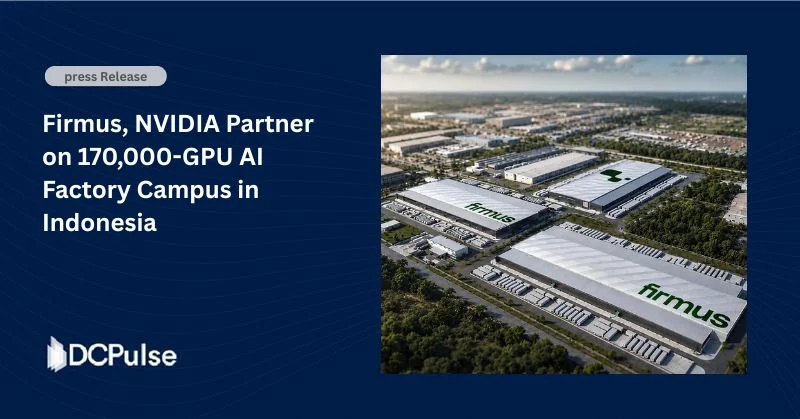
Nvidia-backed data centre operator Firmus pulled its $5 billion Australian IPO after weak demand, cutting its price and still failing to fill the book. The collapse raises questions about how much public markets will pay for AI infrastructure promises.
Australia's Firmus, a data centre operator backed by Nvidia, shelved its US$5 billion initial public offering on Friday, opting for a private fundraising round instead. The decision is the clearest signal yet that public-market investors are becoming more selective about the artificial intelligence infrastructure trade.
A listing that never found its footing
The IPO, expected on October 23, would have been the second-largest new share sale in Australian history. It did not survive contact with investors.
Firmus had already cut its marketed share price from A$11 (US$7.65) to A$9 (US$6.26) earlier in the week after weak demand at home and abroad, according to DataCenterDynamics. Even the reduced figure failed to attract sufficient support.
At the original A$11 price, the company would have carried an equity valuation of US$30.6 billion — roughly triple the US$10.5 billion valuation Firmus achieved after a fundraising round at the start of August, as reported by The Business Times. That jump, against a business with just two operating data centres and no track record of building AI data centres at scale, made investors wary.
"They were asking for a very big price tag for what would likely be expected to happen in the future assuming near flawless execution," said Joseph Koh, a portfolio manager at Blackwattle Investment Partners, who examined the deal but did not bid for stock.
In a statement, Firmus said the IPO terms did not match the strength of its business and its long-term growth outlook. "The board therefore concluded that proceeding with the offer was not in the best interests of the company and its shareholders," it said. The company will now pursue capital from private markets and consider alternative public and private options.
The gap between announcements and delivery
The Firmus setback caps a difficult week. The company had already ended its collaboration with CDC Data Centres on a project known as Project Southgate, which contemplated 1.6GW of capacity in Australia. Only about 43MW was actually delivered under that agreement.
That contrast sits at the heart of the investor scepticism. Neil Osnato, founder of infrastructure advisory firm Persistence Analytics Group, argued the episode is not proof that AI infrastructure demand is unreal, but that capital markets are "beginning to distinguish more sharply between future demand narratives and demonstrated execution."
"Market enthusiasm, customer agreements, announced capacity and delivered operating infrastructure are not the same evidentiary state," Osnato said, pointing to the 1.6GW contemplated under Southgate against the roughly 43MW delivered.
Firmus designs and operates modular AI data centres using proprietary energy and cooling technology. It is backed by Nvidia, Coatue Management, Blackstone and Jane Street, and has signed agreements to provide data centre capacity to Meta and OpenAI in Indonesia and Malaysia. Its draft prospectus projected US$5 billion in annual earnings within five years.
What it means for the wider AI trade
Fund managers quoted by The Business Times framed the pulled deal as a verdict on Firmus rather than on AI more broadly. But the failed listing raises pointed questions for other AI cloud and data centre firms preparing their own public debuts, including UK-based Nscale and US-based Lambda.
The episode unfolds against a broader reassessment of AI valuations. OpenAI's revenue disclosures this week rattled technology stocks, and shares in chipmakers have come under pressure. The tension is straightforward: enormous capital commitments to build AI infrastructure rest on forecasts of future demand, while delivery capability, power availability, construction execution and customer concentration remain dependent on one another.
For now, the message from Australia's capital markets is that enthusiasm alone will not carry a listing. Firms seeking public money will be asked to show what they have built, not just what they have promised.