
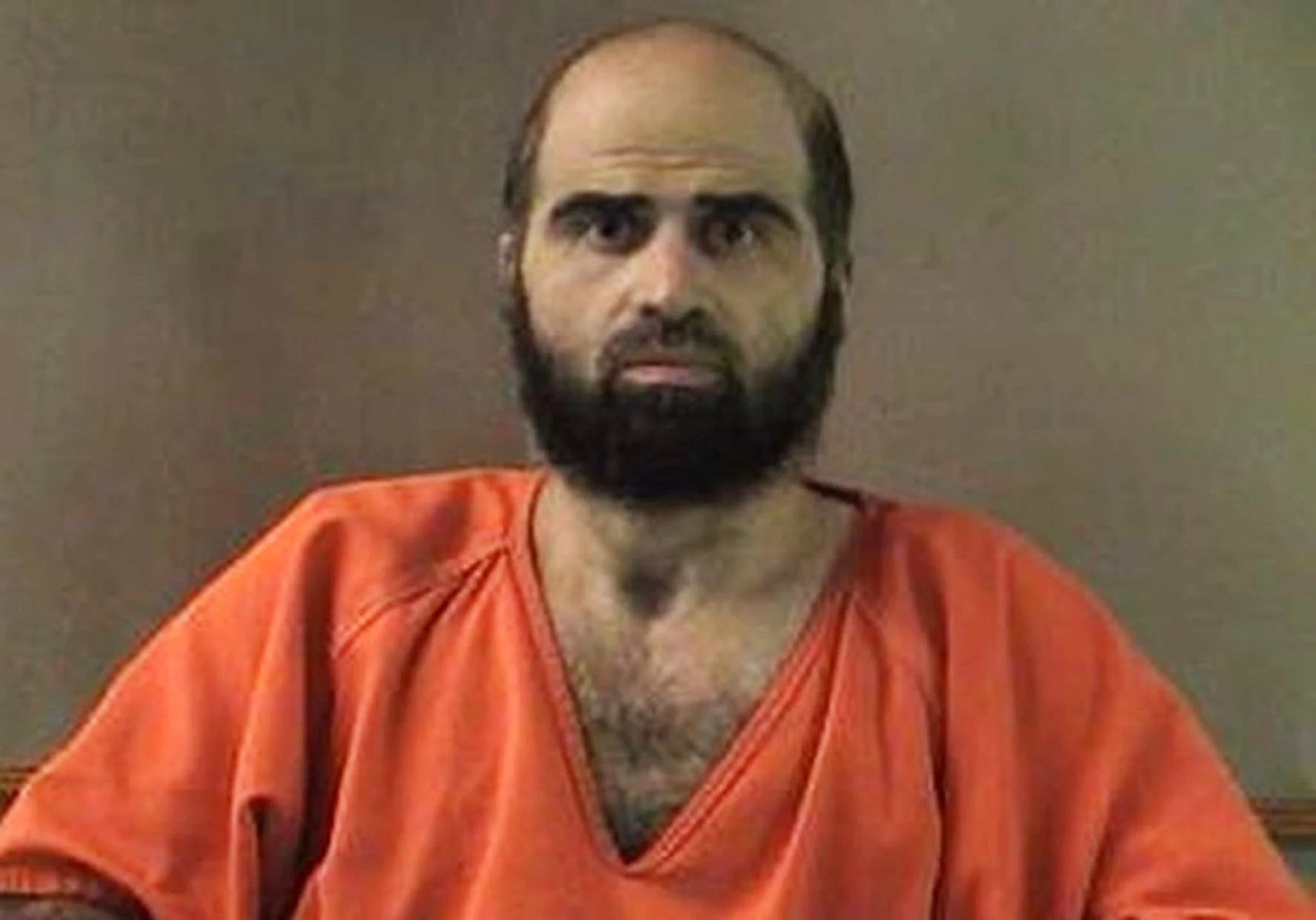
The Pentagon says it will livestream the Dec. 3 firing squad execution of Fort Hood shooter Nidal Hasan, which would be the first publicly broadcast execution in modern U.S. history.
The Pentagon said Thursday it will livestream the December firing squad execution of Nidal Hasan, the former Army major convicted of the 2009 mass shooting at Fort Hood, Texas — a decision that would make the death the first publicly broadcast execution in modern U.S. history.
Defense Secretary Pete Hegseth announced the plan earlier Thursday during an interview with the conservative outlet Real America's Voice. "He's gonna get a firing squad of soldiers, as it should be," Hegseth said. "We'll make sure that people are able to watch it, that it's public — because people need to understand that there's serious consequences for these types of things."
According to the Pentagon, the execution is scheduled for Dec. 3 at Fort Hood at 1 p.m. — the same hour the 2009 attack began. It would be the U.S. military's first execution by firing squad since World War II and its first execution of a service member since 1961.
Approval and Process
The plan to use an Army firing squad was recommended by Hegseth and approved by President Donald Trump, chief Pentagon spokesman Sean Parnell said on social media. Hasan, a former Army psychiatrist, was convicted in a 2013 court-martial of murdering 13 people and wounding more than 30 others when he opened fire in a crowded waiting room where troops were receiving final medical checkups before deploying to Iraq and Afghanistan. At trial, he acknowledged responsibility for the shooting, saying he acted to protect Islamic insurgents from U.S. military forces.
He was sentenced to death by a military jury of 13. He is one of four people on the military's death row, according to the Death Penalty Information Center.
Rare Public Access
Executions in the United States are typically witnessed only by small groups, including reporters and family members of victims. A public execution of any kind has been virtually unheard-of in recent decades; the last widely public spectacle was the 1936 hanging of Rainey Bethea in Kentucky, which reportedly drew around 20,000 people.
The move has drawn scrutiny from legal experts. Geoffrey Corn, a Texas Tech University law professor and former Army Judge Advocate General's Corps officer, told CBS News the decision "raises significant moral questions, above and beyond the questions related to the death penalty generally."
"There's a certain protocol that is normally followed with executions limiting the gallery of observers, which usually includes people close to the victims and certain members of the media," Corn said. "I think it's an acknowledgment of the gravity of the penalty to be imposed." He added that turning the execution into "some type of public spectacle echoes of the past we seem to have put behind us."
The plans also raise questions about how the Army will comply with its own execution guidelines, which state that no person under the age of 18 shall witness an execution.
Legal Challenges Remain Possible
Hasan's attorneys could still seek to delay the execution through court challenges, and the Pentagon has not detailed how the livestream would be produced, restricted, or accessed by the public. Hasan petitioned the Supreme Court in 2024, arguing that the judge at his court-martial had violated his right to a public trial by clearing the courtroom before discussing certain issues with attorneys; the high court declined to take up the case last year.
The decision comes as the Justice Department has signaled openness to alternative execution methods, including firing squads, in federal civilian death penalty cases. In state civilian courts, South Carolina carried out the country's first firing squad executions in more than a decade last year.