
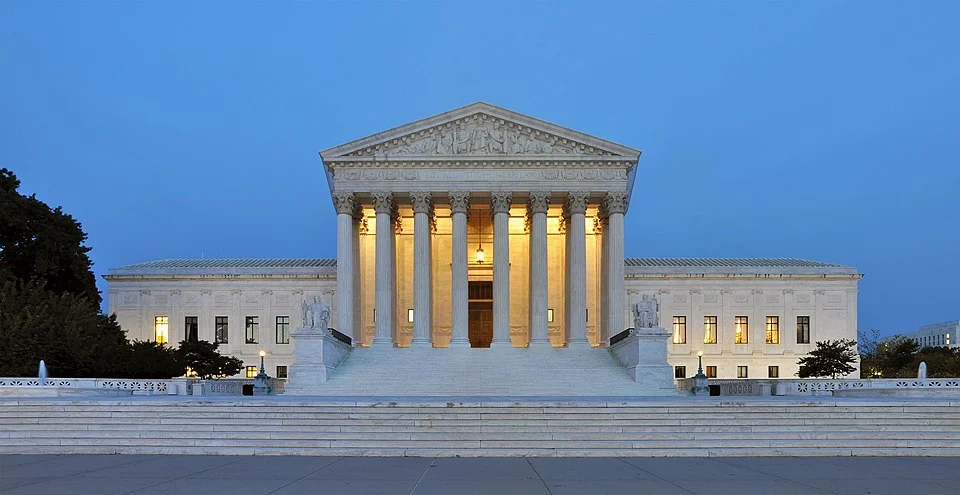
The Supreme Court allowed the Trump administration to use a revamped federal database combining Social Security and immigration records to screen voters, less than six weeks before the Nov. 3 midterms.
The U.S. Supreme Court on Friday cleared the way for the Trump administration to use a revamped federal database that combines Social Security and immigration records to help states identify registered voters whose citizenship status is in question — an interim ruling issued less than six weeks before the Nov. 3 midterm elections.
The unsigned decision lifts restrictions a lower court had placed on the expanded version of the Systematic Alien Verification for Entitlements system, known as SAVE. The court's three liberal justices dissented, with Justice Ketanji Brown Jackson writing that the majority omitted any consideration of the potential harms.
What the ruling does — and does not — decide
The order is a temporary measure. It does not resolve whether the administration's use of Social Security data ultimately complies with federal privacy and Social Security laws; that underlying challenge continues in the lower courts. The decision simply allows the government and states to proceed with the tool while litigation unfolds.
SAVE is a 40-year-old system originally created to check the immigration status of noncitizens applying for public benefits. The Department of Homeland Security overhauled it last year, linking it for the first time to Social Security Administration records — which cover most Americans — and permitting states to upload entire voter rolls for bulk screening.
According to NPR, tens of millions of voter records had already been run through the expanded system before a federal judge in Washington, D.C., blocked it in June. That judge, Biden appointee Sparkle Sooknanan, found the aggregation and disclosure of sensitive data violated federal protections.
The accuracy question
A central concern among election officials is what happens when the database incorrectly flags an eligible voter. The expanded system has already produced errors. In Travis County, Texas, officials reviewed 97 voters flagged by SAVE and found that at least 10 percent — and potentially as many as 21 percent — were U.S. citizens, according to U.S. News & World Report.
Appearing on a list generated by the database therefore does not by itself establish that someone is ineligible to vote. Noncitizens are already barred from voting in federal elections.
The court's majority wrote that the lower court order prevented the federal government "from using the modified SAVE program to conduct individualized inquiries, which are permitted under federal law during this [90-day] period," adding that the order "inhibits the Federal Government's efforts to assist state and local agencies in the proper administration of the midterm elections."
Justice Jackson, in dissent, pointed to the district court's finding of "the risk that States might cancel the voter registrations of at least some recently naturalized citizens or force such persons to provide proof of citizenship before voting."
Timing and the 90-day rule
Federal law bars states from "systematically" removing voters from rolls within 90 days of a federal election, a window that now covers the run-up to Nov. 3. The administration and Republican state officials have argued that the prohibition should not apply to removing noncitizens who were improperly registered, and the government told the court that at minimum the updated SAVE should be usable for individual removal decisions before the election.
Whether the ruling translates into removals before Election Day remains unclear. Todd Belt, a professor of political management at George Washington University, told U.S. News that the compressed timeline makes large-scale removals unlikely.
"I'm not entirely sure voters will get flagged and removed before Election Day this time around," Belt said. "There's just not enough time to implement such a large task." He added that officials should give voters an opportunity to establish eligibility before acting: "The way to balance the goal is to take the process seriously and not to rush it, giving citizens time for due process."
What comes next
States will decide how to use the information, including what steps are required before a registration is changed or canceled. The coalition that challenged the SAVE overhaul — including the League of Women Voters and the Electronic Privacy Information Center — said litigation is ongoing.
"Today's decision is profoundly disappointing, as it puts millions of Americans at risk of being unlawfully targeted by the administration's unreliable voter purge database weeks before the midterm elections," the group said in a statement. "However, this case is not over."
The ruling also clears the way for the administration to continue compiling lists of adult citizens in each state, a separate project that has drawn its own legal challenges. With the district court's underlying decision still on the books, further appeals and additional litigation over how states apply the data appear likely before November.