
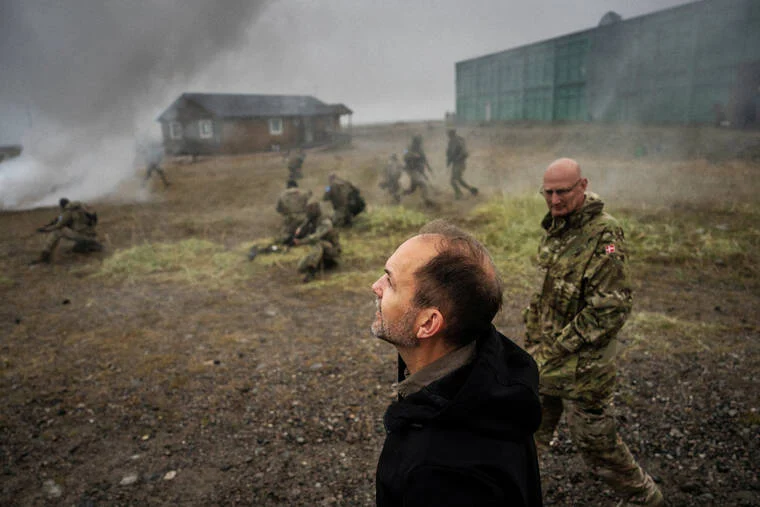
The US, Denmark and Greenland have reached a security agreement Trump says grants Washington 'permanent control' over the Arctic island's security, though Danish officials confirm only that it will be signed at the UN next week.
The United States, Denmark and Greenland have reached an agreement that would expand the American military presence on the Arctic island while barring US adversaries from establishing their own footholds there, President Donald Trump announced Friday. Danish Prime Minister Mette Frederiksen confirmed the deal and said it would be signed next week at the United Nations General Assembly.
Trump, in a post on Truth Social, said the agreement grants Washington "permanent control over security, and all other needs, in Greenland," and claimed it carries "no cost to the United States." He said no US adversary could establish a base, maintain a military presence, or make sensitive investments on the island "without our express written approval."
"At my direction, we worked with representatives of Denmark and Greenland to guarantee that the United States will FOREVER have the complete ability to do what is necessary in Greenland in order to secure and defend the security of Greenland, and the United States of America," Trump wrote. He added that the US would "immediately begin the process of developing a large Military presence" on the island.
Danish confirmation, with caveats
Frederiksen characterized the agreement in narrower terms than the US president. She said it "strengthens our common security in the Arctic and the North Atlantic area" while "at the same time recogniz[ing] the sovereignty and territorial integrity of the Kingdom and the right of the Greenlandic people to self-determination."
She added that the deal still requires approval from legislators and "will have to go through the necessary parliamentary procedures to enter into force" — a detail absent from Trump's announcement.
Jens-Frederik Nielsen, chairman of the Greenland government, said in a statement that it "is gratifying that we are about to enter into an agreement that ensures and strengthens the security" of Greenland, Denmark and the US, adding that the deal "recognises Greenland's interests and our place in international co-operation."
Secretary of State Marco Rubio called it a "historic deal" and a "huge win for the United States and the American people," telling Fox News that it "permanently and completely addresses our national security concerns in Greenland."
Key details remain undisclosed
No text of the agreement has been released, and the White House has not published its terms. Reuters reported earlier Friday, citing unnamed sources, that the US and Greenland were closing in on a deal for an increased American military presence — but one that would stop well short of Trump's long-stated ambition to acquire the island outright.
The announcement also left unclear how the new agreement differs from the existing 1951 defense treaty under which the US has maintained a military presence on Greenland through NATO. The US currently operates Pituffik Space Base, roughly 750 miles above the Arctic Circle.
The deal preserves Greenland within the Kingdom of Denmark, according to the New York Post, but would give Washington veto power over which countries may maintain a military presence there.
Months of tension
The agreement follows months of friction between Washington and Copenhagen. Trump repeatedly suggested the US might purchase or annex the mineral-rich territory and at one point declined to rule out military action, drawing rebukes from Danish officials and other NATO allies. The European Union earlier this year united to rebuke the president over his push to acquire the island, and Greenland's government has consistently maintained the territory is not for sale.
Neither the White House nor the Danish embassy has responded publicly to requests for the agreement's text. Its practical scope — and how far it exceeds the terms of the 1951 treaty — will become clearer when the document is signed and its details released.
Sources: Reuters, BBC, New York Post, Honolulu Star-Advertiser.