
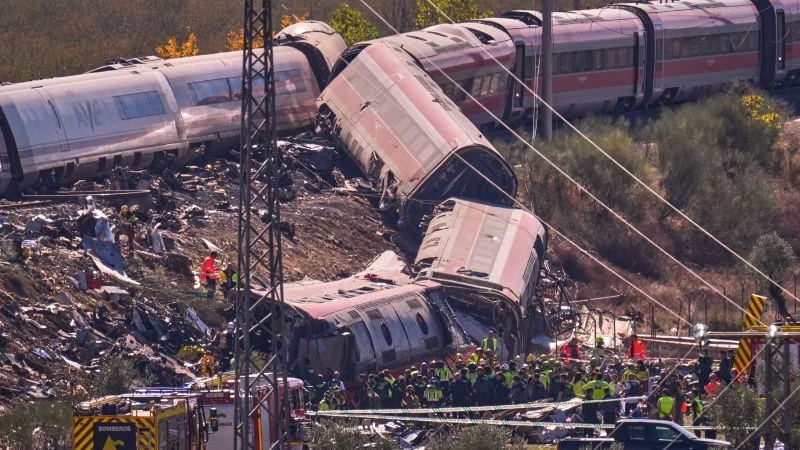
At least 68 people were killed and more than 100 injured after a Renfe high-speed train rear-ended a stopped Iryo train near Urda in Toledo province. Spain's transport minister called the decision to let the train proceed past a red signal "inexplicable."
Two high-speed passenger trains collided near the town of Urda in Spain's central province of Toledo on the morning of 28 October, killing at least 68 people and injuring more than 100, according to officials. The crash is among the deadliest rail accidents in Spanish history and the second fatal collision this year involving the same two operators.
What happened
The collision occurred at roughly 9:15 a.m. local time on the Madrid–Seville line, about 120 km south of the capital. According to Adif, Spain's rail infrastructure manager, a state-owned Renfe train struck the rear of an Iryo train that had stopped on the tracks, derailing carriages on both trains. Both trains were travelling south from Madrid towards Seville.
Spain's transport minister, Óscar Puente, said a failure in the railway's computer communications system had automatically halted traffic along a 63-kilometre stretch of track. Adif then took manual control. Puente said the Renfe train was subsequently authorised to continue despite a red signal indicating a stationary train ahead — an instruction he described as "inexplicable."
"There was a red signal prohibiting movement, yet the train was authorized to proceed," Puente said at a press conference on Wednesday. "It is a decision made under inexplicable circumstances."
Investigators have not yet established a formal cause, and no official report on the accident has been released.
The scene
Passenger footage and photographs from the site showed carriages resting on their sides beside the track and wreckage scattered across an embankment. Survivors described a routine journey interrupted by a violent impact. Fernando Seco, 62, told The New York Times that his carriage filled with screams and panic, and that he and other passengers climbed down an embankment to reach the derailed carriages ahead.
"A rail beam had pierced right through a carriage from bottom to top, like carving meat," Seco said. He and others carried at least a dozen injured people from the wreckage using parts of it as makeshift stretchers. Doctors among the passengers treated the wounded in a field among almond groves before the injured were moved to a sports centre in Urda converted into a temporary treatment site.
The regional government of Castilla-La Mancha said 58 people were receiving hospital treatment. The US State Department said several US citizens were among the injured and did not provide information on their conditions.
Political fallout
Prime Minister Pedro Sánchez visited the crash site and declared three days of official mourning. "If there has been negligence, it will come to light," he said. "If there have been failures in the safety system, we will respond with the utmost firmness."
Opposition leader Alberto Núñez Feijóo of the conservative Popular Party demanded an independent review of the entire rail network and asked what warnings had been drawn from the January crash near Adamuz, in Córdoba province. His party cancelled all campaign events nationwide.
The crash comes roughly a month before a national election, and it is likely to sharpen scrutiny of the government's stewardship of a rail system long regarded as one of Europe's most advanced. The CSIF trade union has called for Puente's resignation.
A second disaster in a year
In January, an Iryo train derailed near Adamuz and two of its carriages fell onto the opposite track, where a southbound Renfe train struck them seconds later. Forty-six people died. Preliminary investigations pointed to a broken rail as the likely cause, but a full official report has not been published.
The recurrence, on the same corridor and involving the same operators, has raised questions about whether safety recommendations from the earlier accident were implemented. Those questions remain unanswered pending the investigation into Wednesday's crash.