
The United States and Iran have reached a preliminary peace agreement following nearly four months of war, with both sides declaring an immediate and permanent cessation of military operations on all fronts, including Lebanon. The memorandum of understanding will be formally signed in Switzerland on June 19.
The agreement, announced through mediator Pakistan and confirmed by Washington and Tehran, includes a 60-day negotiating period during which technical discussions on Iran's nuclear program, sanctions relief, and reconstruction will take place. It is a memorandum of understanding, not a final peace treaty.
What the Deal Includes
According to the draft provisions reported by Iran's Mehr News Agency, the preliminary agreement contains 14 points:
The first and most critical provision is the permanent and immediate end to war on all fronts, including Lebanon. The US has committed to lifting its naval blockade within 30 days and withdrawing military forces deployed around Iran. The Strait of Hormuz will reopen within the same timeframe under arrangements overseen by Iran.
On the economic front, sanctions on Iranian oil and petrochemical sales will be suspended, and Iran will regain access to blocked financial resources. Reports indicate that roughly $24 billion in frozen Iranian assets will be released during the 60-day talks, with half made available before negotiations commence.
The US and its allies are expected to present reconstruction plans worth at least $300 billion for Iran. Washington has committed not to deploy additional forces to the region or impose new sanctions during the negotiation period.
On the nuclear front, the agreement kicks off a 60-day negotiation period to reach a final settlement. Iran has reaffirmed its commitment under the Nuclear Non-Proliferation Treaty not to produce nuclear weapons. A monitoring mechanism will be established to oversee implementation, with final ratification through a UN Security Council resolution.
However, the thorniest issues—including the fate of Iran's existing stockpile of highly enriched uranium and the extent of uranium enrichment restrictions—have been deferred for future negotiations.
Terms of Ceasefire
Iranian Deputy Foreign Minister Kazem Gharibabadi said military operations on all fronts would cease immediately and permanently from June 15. The US maritime blockade of Iran will end on the same day.
The Lebanon element of the ceasefire is particularly significant, as it imposes a halt on the related conflict between Israel and Hezbollah, which had been a key Iranian demand throughout the negotiations.
President Trump announced the immediate lifting of the maritime blockade and authorized the "toll-free" opening of the Strait of Hormuz following the signing ceremony. "Ships of the World, start your engines. Let the oil flow!" Trump posted on Truth Social.
The war, which began when the US and Israel struck Iran on February 28, triggered Tehran to effectively close the Strait of Hormuz—the shipping route for roughly 20 percent of the world's crude oil—by threatening foreign vessels. This led to major spikes in global energy prices.
What Remains Unresolved
The agreement deliberately postpones resolution of the most difficult questions. The 60-day technical talks will address Iran's nuclear program, the scope of sanctions relief, reconstruction mechanisms, and compliance verification.
"The thorniest issues have been deferred for future negotiations, and I'm not terribly optimistic that they're going to be resolved in a 60-day time frame," Karim Sadjadpour, an Iran expert and senior fellow at the Carnegie Endowment for International Peace, told CNN.
Senator Lindsey Graham has signaled that Congress will scrutinize any final nuclear arrangement, noting that under US law any nuclear deal with Iran would require congressional review and a vote.
Iran has also made clear that full negotiations for a final agreement will only begin after Tehran verifies that the US has followed through on its commitments, including ending hostilities, lifting the blockade and releasing assets.
Gharibabadi emphasized that the memorandum "does not mean trusting the enemy," telling Al Jazeera that Iran would monitor US implementation of commitments.
G7 Summit Convened in France
The 52nd G7 Summit officially opened on June 15 in Evian-les-Bains, France, bringing together leaders from the United States, France, the United Kingdom, Canada, Germany, Italy, Japan and the European Union.
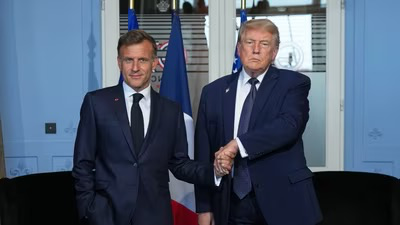
The unexpected US-Iran diplomatic breakthrough is the dominant topic on the summit agenda. French President Emmanuel Macron said the summit would examine the consequences of the agreement, long-term access through the Strait of Hormuz, support for Lebanon, and the need for a wider arrangement covering Iran's nuclear and ballistic missile programs.
Middle East diplomacy is expected to continue on Tuesday, with leaders from Egypt, the United Arab Emirates and Qatar joining discussions.
Beyond the Middle East, the conflict in Ukraine remains a central issue. Ukrainian President Volodymyr Zelenskyy is expected to attend a session on Tuesday as European leaders seek to maintain pressure on Russia and secure continued US backing for Kyiv.
Trade relations between the US and its allies will also attract significant attention, with European countries continuing to express concerns about US tariff policies. AI regulation features on the agenda as well, with technology leaders including OpenAI's Sam Altman invited to a working lunch on Wednesday.
Trump is scheduled to hold bilateral meetings with Macron and other leaders on the summit's sidelines.
What happens next
The June 19 signing ceremony in Switzerland will formally finalize the memorandum of understanding. Following that, the 60-day negotiating period will begin, during which US and Iranian officials will work toward a more comprehensive agreement.
If a final agreement is not reached, Trump has indicated the US could either resume military operations against Iran or assume the role of a "guardian of the Middle East" in exchange for a share of regional revenues.
For global energy markets, the reopening of the Strait of Hormuz is expected to ease supply concerns and stabilize oil prices, though the timing—within 30 days of the signing—remains contingent on both sides adhering to their commitments.
Sources
- https://tass.com/world/2146461
- https://www.cbc.ca/news/world/iran-us-war-agreement-mou-9.7235197
- https://www.news18.com/amp/world/us-iran-peace-deal-14-point-draft-agreement-strait-of-hormuz-sanctions-relief-frozen-assets-nuclear-talks-ceasefire-june-19-switzerland-war-end-ws-l-10149620.html
- https://en.politis.com.cy/news/world/1012511/g7-leaders-gather-in-france-after-us-iran-deal
- https://www.bernama.com/tv/news.php/news.php/news.php/?id=2568576