
Belfast anti-immigration protests turned violent after a knife attack. Homes and vehicles were set ablaze. UK leaders condemn the “outright thuggery.”
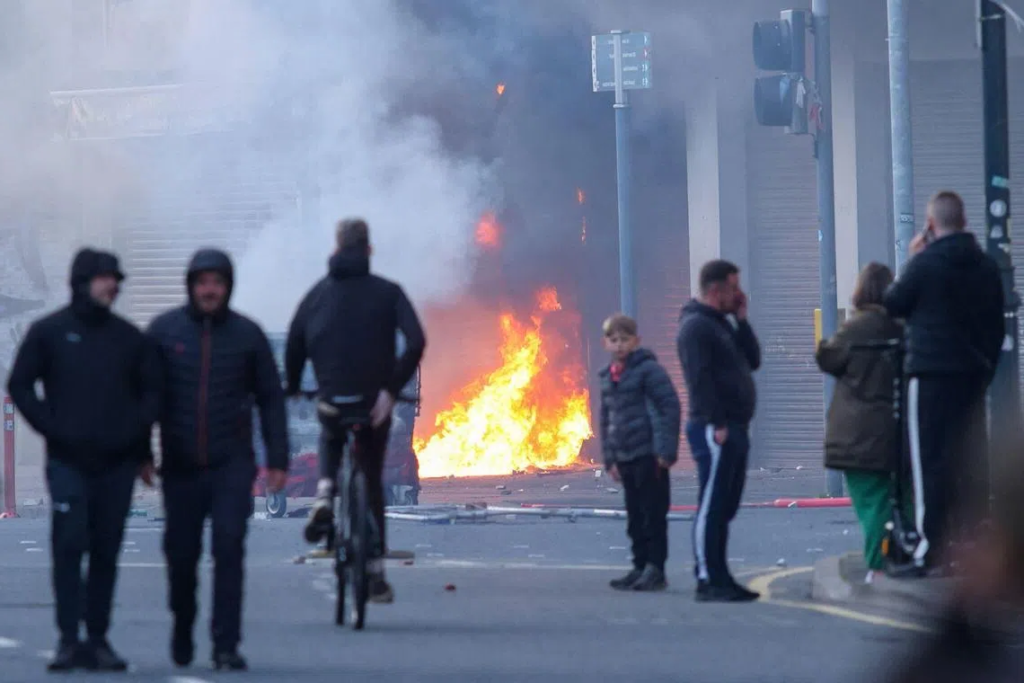
Belfast, Northern Ireland — A wave of violent, anti-immigration protests swept across Belfast on Tuesday night, with masked mobs setting homes and vehicles on fire, hours after police charged a Sudanese man with attempted murder for a brutal knife attack.
The disorder, which saw a bus torched and families reportedly forced from their homes, has drawn sharp condemnation from UK Prime Minister Keir Starmer and Northern Ireland’s First Minister Michelle O’Neill, who described the scenes as “outright thuggery”. The violence marks a significant escalation of racial tensions in the region, fueled by viral social media content and amplified by prominent far-right figures.
Knife Attack and Arrest
The unrest was triggered by an incident on Monday night in north Belfast, where a man in his 40s was seriously injured in a knife attack on Canard Avenue around 10:30 p.m. local time. Police said the victim, who remains in serious condition, suffered significant injuries to his eyes and slash wounds to his face and back. A kitchen knife was recovered at the scene.
On Tuesday, authorities charged 30-year-old Hadi Alodid, a Sudanese national, with attempted murder, possession of a knife, and making threats to kill an NHS radiographer. Alodid made his first court appearance on Wednesday and was refused bail. Police Assistant Chief Constable Ryan Henderson stated there was no information to suggest the attack was terrorism-related, adding that authorities were not seeking other suspects.
Chief Constable Jon Boutcher told reporters that Alodid entered the UK legally. He flew from Paris to Dublin, then traveled by bus to Belfast in February 2023, where he claimed asylum. He was granted a five-year visa in September 2023 and was not known to the Police Service of Northern Ireland (PSNI).
‘Race-Based Pogrom’ Erupts
Within hours of the suspect being charged, hundreds of anti-immigrant protesters took to the streets of Belfast on Tuesday evening. Videos verified by CNN showed homes engulfed in flames as firefighters responded, while a bus was set on fire in east Belfast.
The violence took on a targeted, menacing nature. Pastor Jack McKee told the BBC that members of his church “who have been with us for 20 years” were forced from their homes. “They’re good Christian people and they’re getting put out just because they’re Black,” he said.
Belfast lawmaker Claire Hanna described the events on BBC’s News night as a “race-based pogrom,” stating, “We are seeing men going door to door asking to get the foreigners out based exclusively on the color of their skin”. Social media posts also circulated, with one message reportedly urging men to “be prepared to fight or be arrested”.
Leaders Condemn the Violence
In response to the escalating crisis, Prime Minister Keir Starmer condemned the initial knife attack as “horrific” and “sickening,” while also denouncing the retaliatory violence. “It is clear that people were targeted last night because of their background, and those responsible will feel the full force of the law,” Starmer said.
First Minister Michelle O’Neill of Sinn Féin echoed this sentiment, urging calm. “Racism, intimidation and violence are wrong wherever they occur,” she posted on X. She criticized groups of masked men for “burning families out of their homes”.
The PSNI declared the situation a “critical incident” as armored vehicles were deployed to respond to sporadic disorder across the city. Assistant Chief Constable Ryan Henderson appealed for calm, asking “all voices of influence within local communities to encourage peaceful protest and discourage any involvement in violence or disorder”.
UK on Edge Amid Broader Racial Tensions
The violence in Belfast is the latest flashpoint in a period of heightened racial and social tension across the UK. The situation has been amplified online, with billionaire Elon Musk among the US right-wing figures reposting and amplifying content calling for demonstrations.
The unrest also follows last week’s sentencing of Vickrum Digwa, a Sikh man who was convicted of murdering a white university student, Henry Nowak. The case, in which police initially handcuffed the dying victim, has been seized upon by anti-immigration activists and US Vice President JD Vance to stoke racial grievances.
What Happens Next
Police have urged the public not to share graphic images of the knife attack or spread disinformation online. Authorities have also appealed for residents to remain calm and allow police to complete their investigation. The suspect, Hadi Alodid, remains in custody as the judicial process continues. The PSNI has stated it will maintain a visible presence on the streets to prevent further disorder.
FAQ
Q: What sparked the violent anti-immigration protests in Belfast?
A: The protests were sparked by a knife attack in north Belfast on Monday, June 8, 2026, in which a man in his 40s was seriously injured. Police subsequently charged a 30-year-old Sudanese man, Hadi Alodid, with attempted murder.
Q: Who is the suspect charged in the Belfast knife attack?
A: The suspect is Hadi Alodid, a 30-year-old Sudanese national. He appeared in court on June 10, 2026, charged with attempted murder, making threats to kill an NHS radiographer, and possession of a knife. He was refused bail.
Q: What happened during the anti-immigration protests in Belfast?
A: On the evening of June 9, 2026, hundreds of masked protesters gathered across Belfast, setting a bus, cars, and residential homes on fire. There were reports of mobs going door-to-door and targeting homes of ethnic minority families.
Q: How did UK Prime Minister Keir Starmer respond to the violence?
A: Prime Minister Keir Starmer condemned the initial knife attack as “horrific” and the subsequent riots as “abhorrent.” He stated that those who targeted people because of their background would “feel the full force of the law.”
Q: Was the suspect in the Belfast knife attack legally in the UK?
A: Yes. Police confirmed that the suspect entered the UK legally, traveling from Paris to Dublin before arriving in Belfast in February 2023. He claimed asylum and was granted a five-year visa to remain in the UK in September 2023.
KEY TAKEAWAYS
- A 30-year-old Sudanese man, Hadi Alodid, has been charged with attempted murder for a knife attack in north Belfast.
- The attack triggered violent anti-immigration protests in Belfast on June 9, 2026, involving the torching of homes, vehicles, and a bus.
- Political leaders including Keir Starmer and Michelle O’Neill have condemned the disorder as “outright thuggery” and a “race-based pogrom.”
- Police have declared the situation a “critical incident” and are urging calm, confirming the suspect legally entered the UK and is not known to security services.
- The violence is occurring against a backdrop of heightened racial tensions across the UK, amplified by far-right figures and viral social media content.