
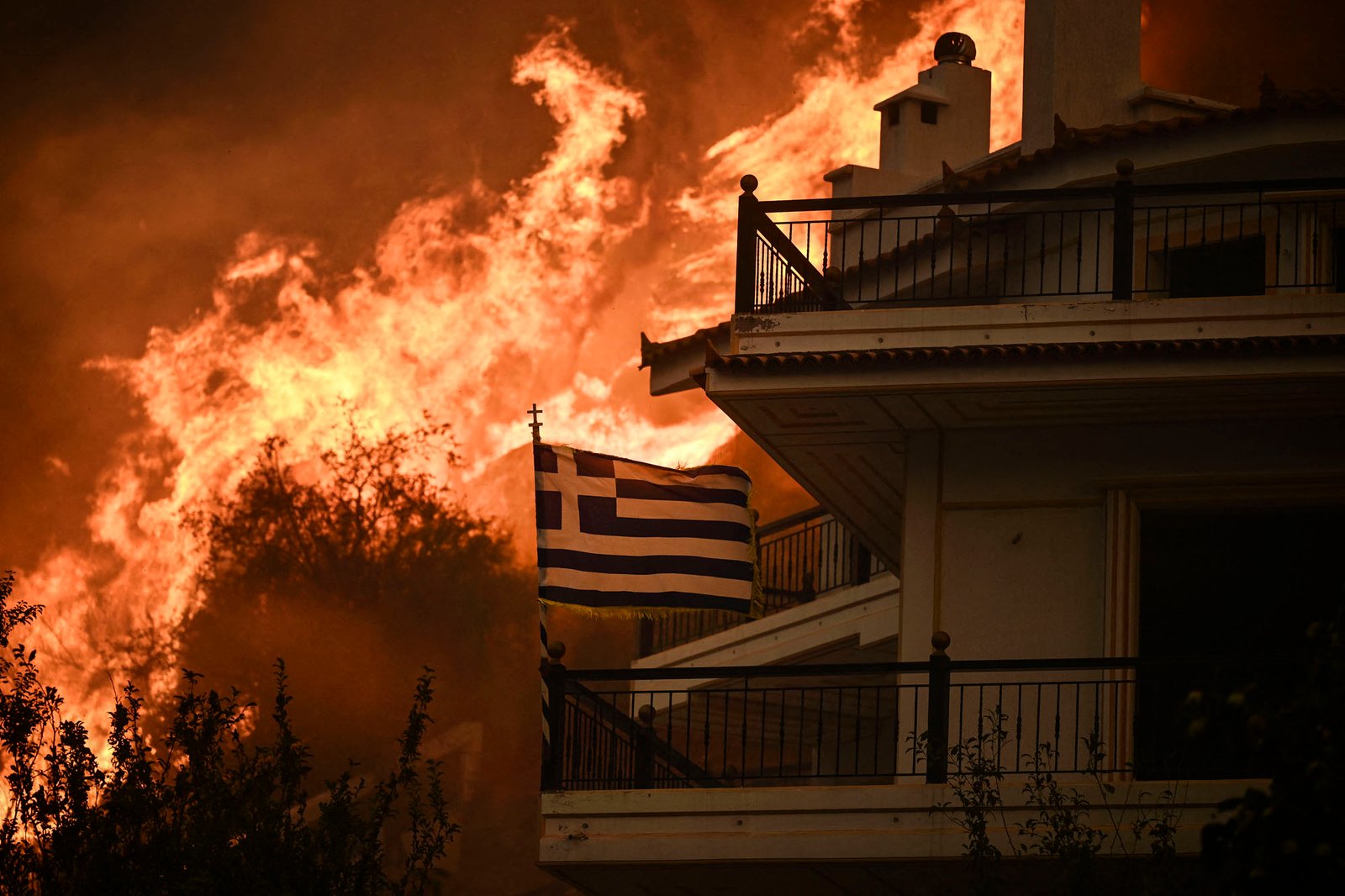
Deadly Greece wildfires 2026 claim seven lives, destroy homes and force mass evacuations. Latest updates on Attica blazes, Salamina tragedy, and expert safety guidance.
A devastating wildfire crisis continues to grip Greece in August 2026, with at least seven lives lost, scores of homes destroyed, and more than 12,600 hectares of forest and farmland reduced to ash. The fires—driven by relentless strong winds, scorching temperatures, and prolonged drought—have forced thousands of residents and tourists to flee by land and sea across multiple regions, including western Attica, the island of Salamina, Crete, and the northern resort of Halkidiki. The blazes have overwhelmed firefighting resources, claimed the lives of two helicopter crew members in a mid-air collision, and prompted Greece’s Civil Protection agency to place half the country under category-3 fire risk. As climate change amplifies Mediterranean fire conditions, experts warn that 2026 may rank among Greece’s worst wildfire seasons in a decade.
Key Developments
August 20: Three Wildfires Contained as Risk Persists
Water-dropping aircraft and ground forces brought three wildfires under control on August 20 across mainland Greece. Firefighters contained a blaze near the village of Kremasti in the Sparta region of the southern Peloponnese, supported by four aircraft and 35 firefighters. Two additional fires near Palamas in the central Karditsa region and Paralimni in northern Serres were also subdued. However, civil protection authorities warned that approximately half the country remained at category-3 risk, including the Greater Athens region, the Peloponnese, Crete, Evia, and nearly all Aegean islands.
Salamina: Tragedy at Sea and on Land
Earlier in the week, two wildfires broke out nearly simultaneously on the island of Salamina, near Piraeus. The first ignited at 2:43 PM in Peristeria, followed by a second at 3:03 PM in the Kaki Vigla-Selinia area. Strong winds drove flames rapidly through mixed forest and residential zones. The Fire Service deployed 192 firefighters, nine EMODE special forest firefighting units, 32 vehicles, six aircraft and eight helicopters.
The 112 emergency alert system was activated repeatedly, ordering evacuations from Peristeria, Aias Club, Kolones, DEI Chalióti, Perani and Kaki Vigla. With land routes blocked by fire and smoke, coast guard vessels and private boats evacuated more than 90 people by sea from Saterli and Kolones. Two bodies—believed to be an elderly couple—were found in Peristeria. Eight people suffered burns and were treated at Salamina Health Center.
Fatal Helicopter Collision Near Psatha
The firefighting operation suffered a devastating blow on August 2 when two firefighting helicopters collided mid-air near the coastal community of Psatha, west of Athens. Both crew members died in the crash. Authorities are investigating the cause of the collision.
Halkidiki and Crete: Mass Evacuations
On August 13, a major wildfire forced evacuations in the northern Greek resort of Siviri on the Halkidiki peninsula. Strong winds drove the fire’s rapid spread, prompting approximately 350 people to evacuate by sea, with two firefighters injured. Greece’s Climate Crisis and Civil Protection Minister Evangelos Tournas reported that since the fire season began on May 1, Greece has experienced approximately 2,700 forest fires.
In late July, Crete witnessed large-scale evacuations, with 8,000 people forced to flee the Rethymno region. Two firefighters died battling the blaze on the island.
Arrests and Investigations
Greek authorities have made over 300 arrests in connection with wildfires since the beginning of 2026. Fire department spokesman Giorgos Artopoios confirmed 272 arrests for negligence and 36 for deliberate arson. Investigators have linked several major fires to faults in electricity networks. Among those charged is Ioannis Apostolou, mayor of the coastal town of Stilida, whose electrical installation company allegedly operated power cables that sparked a blaze near Athens.
Context and Background
A Decade of Devastation
Greece suffers devastating wildfires every summer as hot, arid conditions leave the countryside tinder-dry and strong seasonal winds fan any blaze. Since 2018, six major fires in Attica have burned over 48,000 hectares—approximately 40 percent of the forest land surrounding Athens. The 2018 Mati wildfire remains Greece’s deadliest, claiming 104 lives. The 2023 Evros blaze and the 2021 northern Evia megafire—which destroyed tens of thousands of hectares—further cemented the eastern Mediterranean’s status as one of Europe’s most wildfire-vulnerable regions.
‘One of the Worst Fire Crises’
Theodore Giannaros, a senior wildfire meteorologist at the National Observatory of Athens, told AFP that Greece is facing “one of the worst fire crises” in recent memory. “Climate change is indeed creating conditions that are highly conducive to these kinds of fires, allowing them to spread very easily and become uncontrollable,” he said. However, he stressed that “95 percent, or even more, of ignitions are caused by human activity, either through arson, negligence or land management”. Greece, he added, has long neglected rural and forested areas: “We have abandoned our rural areas. Our forests are not being managed efficiently. The climate crisis is simply increasing the toll”.
The wildfire in western Attica is likely to be classified as a megafire, having exceeded the 10,000-hectare threshold commonly used to define such events. According to the European Forest Fire Information System (EFFIS), Greece has recorded 39 major fires since the start of 2026, burning nearly 32,000 hectares.
Wildfire Protection: Official Guidance for the Public
As wildfires continue to threaten communities across Greece, authorities have issued comprehensive guidance for protecting life and property. The following measures draw from Greece’s Ministry of Climate Crisis and Civil Protection, the Ministry of Health, and international emergency response organizations.
Preparing Your Home
Greece’s Civil Protection agency recommends creating a defensible space around homes:
- Clear dry leaves, vegetation, pine needles and branches within a 10-meter radius of your home
- Prune trees up to 3 meters in height and ensure branches do not touch the building
- Thin trees so branches are at least 3 meters apart
- Remove flammable items and firewood from near the house
- Install non-flammable chimney and vent covers
If Fire Approaches
When wildfire threatens, the Civil Protection agency advises:
- Close all doors and windows firmly
- Block cracks with wet clothes or towels to prevent smoke penetration
- Remove curtains from windows
- Turn off gas supplies at the tank if instructed
- Move combustible furniture away from windows
Smoke Safety
Greece’s Ministry of Health has issued urgent guidance on protecting against wildfire smoke, which contains harmful pollutants including carbon monoxide, nitrogen oxides, sulphur dioxide and fine particulate matter (PM2.5). These particles can penetrate deep into the lungs and enter the bloodstream.
Vulnerable groups include: people with asthma or respiratory illnesses, those with cardiovascular disease, individuals with chronic conditions, older adults, children, pregnant women and smokers.
- Stay indoors with windows, doors and openings closed
- Reduce unnecessary travel, even if flames are not nearby but smoke is present
- Use air conditioning on recirculation moderather than drawing in outside air
- Wear a well-fitted N95, FFP2 or KN95 maskwhen outdoor travel is unavoidable
- Stay hydrated—drink water and avoid sugary or alcoholic beverages
- Avoid smoking indoors or using fireplaces, barbecues or aerosols
- Check on elderly neighbors and people living alone
Seek immediate medical attention for severe shortness of breath, confusion, seizures, chest pain, breathing difficulties, loss of consciousness, or burns.
Evacuation Preparedness
International emergency organizations recommend:
- Sign up for local emergency alerts (Greece uses the 112 emergency system)
- Prepare a “go bag” with: one gallon of water per person per day, non-perishable food for 72 hours, prescription medications, N95 masks, cash, flashlight, batteries, first aid kit, battery-powered radio, important documents and phone chargers
- Plan multiple evacuation routes and designate meeting points for family members
- Back your car into the garage or park facing the evacuation route
- Keep pets in one room so they can be found quickly if evacuation is ordered
- Obey all evacuation orders immediately—do not wait
If Trapped Outdoors
The American Red Cross advises:
- Crouch in a pond, river or pool if available
- Do not put wet clothing over your mouth—moist air can cause more airway damage than dry air at the same temperature
- If no water is available, seek shelter in a cleared area or among rocks, lie face-down and cover your body with soil
- Breathe air close to the ground to avoid scorching your lungs or inhaling smoke
What Happens Next
Firefighters remain on high alert across Greece as the fire season—which typically extends into late autumn—continues. Authorities have warned that many regions face continued extreme risk, with category-4 alerts issued for areas around Athens. The newly passed Active Battle civil protection law, approved this spring, has yet to be fully implemented. Giannaros expressed cautious optimism about Greece’s improved forecasting and early-warning systems but stressed that “much work remains to be done”.
With Mediterranean countries facing increasingly severe fire conditions driven by climate change, experts warn that Europe’s wildfire crisis is intensifying. Greece’s ability to prevent negligence-related ignitions, enforce accountability, and implement long-term land management reforms will be critical in mitigating future disasters.
FAQ
Q: How many people have died in the Greece wildfires in 2026?
A: At least seven people have died in the Greece wildfires as of August 2026, including two elderly individuals on Salamina island, two helicopter crew members killed in a mid-air collision near Psatha, and two firefighters who died battling the Crete blaze.
Q: What areas of Greece are affected by wildfires in August 2026?
A: Major fires have burned across western Attica, the island of Salamina, Crete, the Halkidiki peninsula, the Peloponnese, Karditsa, Serres, Kefalonia, and Limnos.
Q: What caused the Greece wildfires in 2026?
A: While climate change creates conditions conducive to fire spread, approximately 95% of ignitions are caused by human activity—either arson, negligence, or poor land management. Investigators have linked several fires to faults in electricity networks.
Q: How can I protect myself from wildfire smoke in Greece?
A: Stay indoors with windows closed, use air conditioning on recirculation mode, wear an N95 or FFP2 mask if you must go outside, stay hydrated with water, and avoid smoking or using fireplaces indoors.
Q: What should I do if I receive a 112 evacuation alert in Greece?
A: Evacuate immediately following the instructions provided. Have a go-bag ready with water, food, medications, important documents, and N95 masks. Use your planned evacuation route and do not delay.
Q: Is it safe to return home after a wildfire evacuation?
A: Do not return until officials say it is safe. Inspect your roof for embers that could reignite, check for signs of fire or smoke, avoid damaged power lines, and throw out food exposed to heat or smoke.
Q: How can I prepare my home for wildfire season in Greece?
A: Clear dry vegetation within 10 meters of your home, prune trees up to 3 meters high, remove flammable items from near the house, and install non-flammable chimney covers.
Key Takeaways
- At least seven people have died in Greece’s August 2026 wildfires, with over 12,600 hectares burned in Attica alone
- More than 300 arrests have been made for wildfire-related offenses in 2026, with 272 cases involving negligence
- Greece faces “one of the worst fire crises”in a decade, with experts linking the severity to climate change and human activity
- The 112 emergency alert system has been activated repeatedly, with evacuations by land and sea across multiple regions
- Official guidance emphasizes creating defensible home space, wearing N95/FFP2 masks in smoke, and evacuating immediately when ordered
- The Active Battle civil protection law, passed in spring 2026, has yet to be fully implemented as the fire season continues