
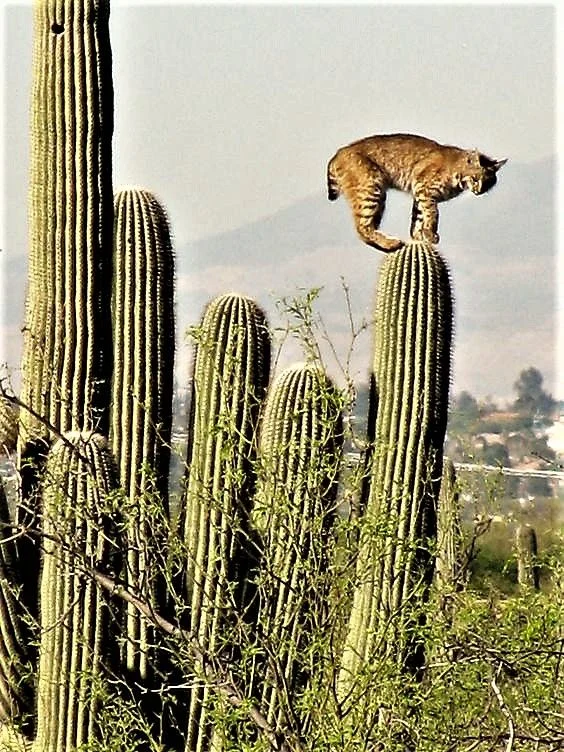
Viral posts claim bobcats climb saguaros to escape desert heat, citing 'studies.' Recent peer-reviewed research on bobcat behavior in the Southwest is real — but it doesn't support that explanation.
Every few months, a photograph of a bobcat sitting atop a towering saguaro circulates online, usually paired with a tidy explanation: the cat scales the spine-covered cactus to escape the desert heat. The claim is repeated as settled fact, often attributed vaguely to "studies."
The photographs are real. The explanation is not well supported.
A gap between viral claims and the published record
Search the peer-reviewed literature on bobcat (Lynx rufus) behavior and you will not find a dedicated study establishing cactus-climbing as a routine behavioral adaptation for heat regulation. The authoritative reference used by wildlife professionals — the San Diego Zoo Wildlife Alliance's compiled bobcat fact sheet — describes daily rest shelters as rocky ledges, steep slopes, brush, abandoned burrows, hollow logs and tree stumps. When threatened, the sheet notes, bobcats flee by hiding in nearby rocks or climbing a tree. Cactuses do not appear in the documented ethogram.
The viral explainers that assert otherwise tend to trace back to each other rather than to primary research. One widely shared version cited a commercial pet-interest website as its source. That is not evidence of a scientific finding; it is evidence of a claim propagating without one.
What the recent science does show
Genuine research on bobcat behavior in the American Southwest is active — it simply focuses elsewhere. In January 2026, a University of Arizona-led team posted a preprint analyzing GPS tracking data from the Bobcats in Tucson project, a multi-year study of urban bobcats on the city's western edge. The findings were about roads, not cactuses: bobcats crossed roads roughly 11 percent less often than random chance would predict, an effect driven mainly by interstates and major local roads. The authors found little evidence the animals selectively used culverts or underpasses, and concluded that simply building wildlife crossings is insufficient — fencing, rumble strips, reduced speed limits and driver-warning signs may do more to reduce collisions.
Other recent work has examined bobcat activity patterns at broad scales. A 2025 study in the journal Ecology and Evolution used citizen-science camera-trap records to characterize the species' activity across Mexico, noting that its behavior there had previously been poorly evaluated at national scale. The recurring theme in this literature is timing — bobcats concentrate activity in the cooler early-morning and dusk hours, coinciding with the activity of prey such as rabbits — not vertical refuge in plants.
Why the cactus story persists
There is a reasonable kernel here, encased in overreach. Desert animals do seek relief from radiant ground heat, and an elevated vantage point would offer both cooler air and a clearer view of prey and threats. Bobcats are capable climbers and do use trees defensively. It is not impossible that an individual bobcat occasionally rests on a saguaro.
But rare, opportunistic behavior captured in a photograph is not the same as a documented adaptation, and the two are routinely conflated online. The existence of striking images does not substitute for the systematic observation that would establish how often the behavior occurs, under what conditions, and whether it confers a survival advantage.
The takeaway
Bobcats are genuinely under active scientific study in the Southwest, and the work is yielding concrete findings about how they navigate roads, cities and changing habitat. The cactus-perching narrative, by contrast, is better documented in viral posts than in journals. Until researchers publish direct observational evidence, the honest position is that the behavior is plausible but unproven — and the confident explanations attached to those photographs are running well ahead of the science.