
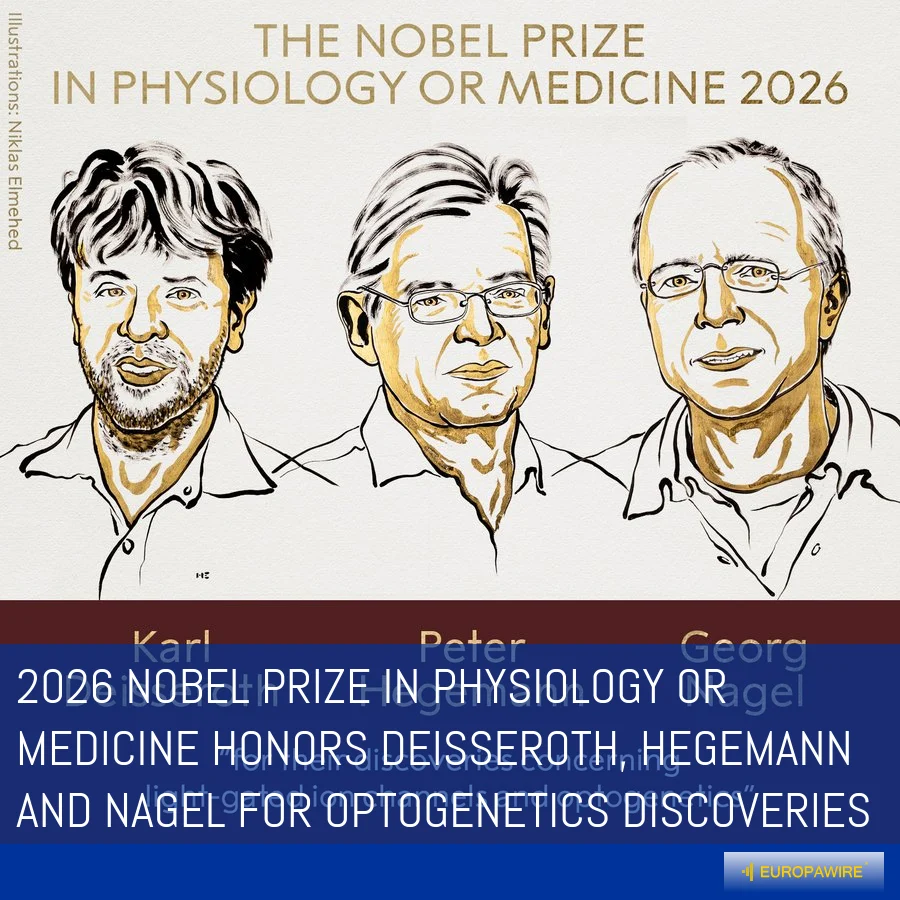
Karl Deisseroth, Peter Hegemann and Georg Nagel win the 2026 Nobel Prize in Physiology or Medicine for discovering light-gated ion channels and developing optogenetics.
The 2026 Nobel Prize in Physiology or Medicine has been awarded jointly to Karl Deisseroth, Peter Hegemann and Georg Nagel "for their discoveries concerning light-gated ion channels and optogenetics," the Nobel Assembly at Karolinska Institutet announced on 5 October.
The prize, worth 12 million Swedish kronor, is shared equally between the three laureates. It recognises a technique that gave neuroscience something it had long lacked: a way to switch individual nerve cells on and off with a beam of light, and to watch what happens next.
From an alga to the brain
The work began with a question about how single-celled algae steer toward light. In the early 2000s, Peter Hegemann, now at Humboldt University of Berlin, and Georg Nagel, now at the University of Würzburg, identified a protein in the alga Chlamydomonas called channelrhodopsin. When blue light strikes it, a channel opens and charged ions flow into the cell, producing an electrical impulse. The protein worked in other cells too, making them light-sensitive.
Karl Deisseroth, at the Howard Hughes Medical Institute and Stanford University, took the next step. He introduced the channelrhodopsin gene into rat nerve cells and used blue light to trigger a nerve signal, publishing the result in 2005. Two years later he made the method work in the brains of living mice.
That combination — a light-sensitive ion channel plus a way to deliver it to neurons — is what became known as optogenetics.
Why it mattered
Before optogenetics, researchers could observe brain activity and correlate it with behaviour, but struggled to prove cause and effect. The method let them stimulate precisely chosen cells and observe the consequences, turning correlation into a causal test.
"Optogenetics provides opportunities for mapping the brain in a way that we could once only dream of," said Per Svenningsson, chair of the Nobel Committee for Physiology or Medicine.
Since 2005 the technique has spread across neuroscience. Researchers have used it to trace neural circuits behind specific memories, feelings and behaviours, including the circuits relevant to neurological and psychiatric disorders. In clinical medicine, it is being tested in attempts to restore sight in people with visual impairment.
The laureates
Karl Deisseroth, born in Boston in 1971, earned his Ph.D. in 1998 and his M.D. in 2000 from Stanford University. He is the D.H. Chen Professor of Bioengineering and of Psychiatry and Behavioral Sciences at Stanford and the Howard Hughes Medical Institute.
Peter Hegemann, born in 1954, completed his Ph.D. in 1984 at the Max Planck Institute for Biochemistry in Martinsried. He is Hertie Senior Professor of Neuroscience at Humboldt University of Berlin. The prize-winning discoveries were made at the Max Planck Institute for Biochemistry.
Georg Nagel, born in 1953, earned his Ph.D. in 1988 at the University of Frankfurt. He is Professor of Molecular Plant Physiology at the University of Würzburg. The prize-winning discoveries were made at the Max Planck Institute of Biophysics in Frankfurt.
What's next in Stockholm
The medicine award opens this year's Nobel season, with further prizes to be announced through 12 October. The prize ceremony is traditionally held on 10 December, the anniversary of Alfred Nobel's death.