
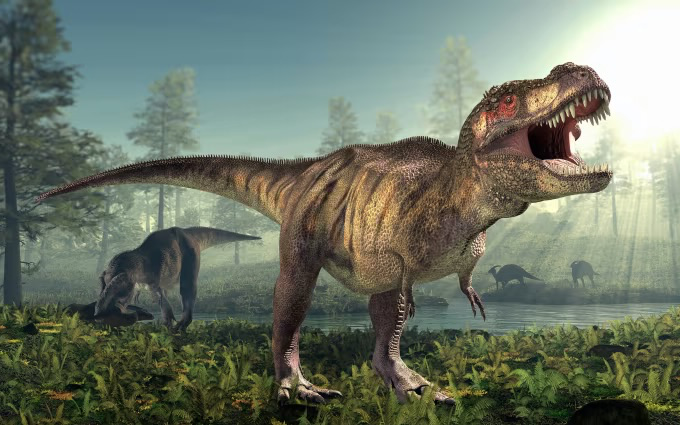
A new dinosaur study suggests T. rex evolved tiny arms because its massive skull became its primary hunting weapon, reshaping theories on theropod evolution.
Why did T. rex have tiny arms?
A 2026 study suggests T. rex evolved tiny arms because its massive skull and jaws became its primary hunting tools, reducing the evolutionary need for large forelimbs.
Who conducted the T. rex arm study?
The research was led by Charlie Roger Scherer at University College London, with contributions from researchers at the University of Cambridge.
Where was the study published?
The findings were published in Proceedings of the Royal Society B in May 2026.
Was T. rex the only dinosaur with tiny arms?
No. The study found several carnivorous dinosaur groups independently evolved reduced forelimbs, including Carnotaurus and Majungasaurus.
Did T. rex arms have any function?
Scientists say the arms were likely still useful and muscular, but their exact function remains uncertain. Hypotheses include helping with prey handling or movement.
How many dinosaur species were analyzed?
Reports vary slightly, but researchers examined roughly 82 to 85 theropod species across multiple evolutionary lineages.
Why is this study important?
The research provides one of the strongest comparative analyses linking skull evolution and arm reduction in predatory dinosaurs, offering new insight into theropod evolution.
Scientists Link T. rex’s Tiny Arms to Evolution of Massive Hunting Skulls
A new study published in May 2026 may have answered one of paleontology’s most enduring questions: why did Tyrannosaurus rex evolve such tiny arms? Researchers from University College London and the University of Cambridge say the dinosaur’s reduced forelimbs were likely the evolutionary trade-off for developing one of the most powerful skulls in prehistoric history. The findings, published in Proceedings of the Royal Society B, analyzed dozens of carnivorous dinosaur species and suggest that giant predators increasingly relied on crushing bites rather than grasping prey with their arms.
The study revisits a debate that has persisted for more than a century. Despite its reputation as one of Earth’s most formidable predators, T. rex had forelimbs measuring only about three feet long on a body that could exceed 40 feet in length. Scientists have long proposed explanations ranging from mating behavior to prey restraint, but no consensus had emerged.
Researchers Found a Pattern Across Multiple Dinosaur Families
The research team examined between 82 and 85 species of theropod dinosaurs, depending on reporting summaries, covering five major carnivorous lineages including tyrannosaurids, abelisaurids, ceratosaurids, megalosaurids, and carcharodontosaurids.
Their analysis identified a recurring evolutionary pattern: dinosaurs with the most heavily built skulls consistently had the shortest forelimbs.
Lead author Charlie Roger Scherer, a PhD researcher at UCL Earth Sciences, argued that giant predators increasingly shifted their hunting strategy toward using their heads and jaws as primary weapons. According to the study, once powerful bites became the dominant method of killing prey, arms became less essential and gradually shrank over evolutionary time.
Researchers described the process as a form of evolutionary specialization. Large herbivores such as sauropods may have pushed predators toward head-first attack strategies because relying on claws against enormous prey was less effective.
T. rex Was Not the Only Dinosaur With Reduced Arms
The findings emphasize that T. rex was not unique. Other giant meat-eating dinosaurs also evolved disproportionately small forelimbs independently over millions of years and across different continents.
One example highlighted in the research was Carnotaurus, whose forelimbs were even smaller relative to body size than those of T. rex. Another was Majungasaurus, an apex predator from Madagascar that weighed far less than T. rex but still evolved extremely reduced arms alongside a robust skull.
The study argues this repeated pattern strengthens the case that forelimb reduction was driven by hunting adaptation rather than random evolutionary drift.
Researchers also found that different dinosaur groups reduced their arms in different anatomical ways. In some species, the hands became especially diminished, while others experienced more evenly distributed shortening throughout the limb.
The Skull Became the Main Weapon
To test the relationship between skulls and forelimbs, scientists developed a method for measuring skull robustness using factors including bite force, skull shape, and bone connectivity. T. rex ranked as the most robust skull analyzed in the study.
The researchers concluded that stronger skulls were more closely linked to tiny arms than overall body size. That distinction is important because earlier theories often assumed arm reduction was simply a side effect of becoming enormous animals.
Instead, the new findings suggest giant theropods underwent a broader functional redesign in which the skull effectively replaced the arms as the primary hunting tool.
Still, the study stops short of claiming the arms were useless. Scientists note that T. rex forelimbs remained muscular and may have retained secondary functions, though their exact purpose remains unclear.
Debate Continues in Paleontology Circles
While the research has attracted widespread attention, some paleontologists and online commentators note that the “large head, smaller arms” theory has circulated for years. The new study’s contribution lies in quantitatively comparing multiple theropod groups and measuring skull robustness across species.
Other theories about T. rex arms have not disappeared entirely. Previous hypotheses suggested the limbs may have helped stabilize prey, assisted with rising from the ground, or played a role in mating behavior. Fossil evidence also indicates the arms were powerful despite their short length.
Because fossil records remain incomplete, researchers acknowledge that no single study can definitively settle every question about dinosaur behavior.
Why the Findings Matter Beyond Dinosaurs
The study highlights a broader principle in evolutionary biology: species often specialize by amplifying one highly effective trait while reducing others. In the case of T. rex and related predators, that specialization appears to have favored skull strength and bite power over forelimb utility.
The findings also contribute to ongoing efforts to better understand how prehistoric ecosystems evolved during the Cretaceous period, when predator-prey dynamics became increasingly extreme.
Public fascination with T. rex continues to drive scientific and commercial interest in paleontology, museum exhibitions, documentaries, and entertainment franchises such as Jurassic Park. New research on iconic species often generates significant public engagement because it reshapes how audiences imagine prehistoric life.
What Happens Next
Researchers say future work will likely focus on how these evolutionary changes developed biomechanically over millions of years and whether similar trade-offs appear in other extinct species.
The study also opens new questions about how dinosaur behavior changed as anatomy evolved. While the mystery of T. rex’s tiny arms may not be completely solved, scientists now believe they were part of a much larger evolutionary strategy centered on building one of nature’s deadliest skulls.