
Democrats have won full control of Congress, NBC News projects, flipping Senate seats in Texas, Kansas, Iowa, Ohio, North Carolina and South Carolina amid deep voter anger over the economy and Trump's conduct.
Democrats have won control of both chambers of Congress, according to projections by NBC News and CNN, completing a sweep that extends well beyond the party's own pre-election expectations and hands President Donald Trump an opposition legislature for the final two years of his term.
The Senate result was confirmed overnight, with Democrats holding a projected 53 seats to 41 for Republicans, a net gain of seven. The House fell earlier in the evening, and Democratic strategists expect the final majority to be the party's largest in nearly two decades.
A map that broke in unexpected places
The scale, rather than the direction, of the result is the story. Democrats needed a net gain of three House seats to take the chamber; they secured far more. The party also flipped Republican-held Senate seats in Iowa, Kansas, Ohio, North Carolina, South Carolina and Texas, a state Democrats had not won at the statewide federal level in three decades.
South Carolina, which many Democratic operatives had written off as out of reach, was projected early — an outcome that campaign officials in both parties describe as the first clear signal of the night. In Texas, state Representative James Talarico defeated Attorney General Ken Paxton by 55.1% to 43.1%, and CNN reported that Democrats were also on course to win the governor's office there for the first time this century.
Not every race is settled. NBC News lists six uncalled Senate contests, including Mississippi, where Republican incumbent Cindy Hyde-Smith leads Democrat Ty Pinkins 49.3% to 48.6% with 96% of the vote counted, and Nebraska, where Republican Pete Ricketts leads independent Dan Osborn. Michigan remains Democratic-leaning but uncalled. The margins in the called races are wide enough that the outstanding seats do not affect control.
Why voters switched
The NBC News Exit Poll points to two dominant drivers: disapproval of the president and the cost of living. Forty-three percent of midterm voters said opposition to Trump was one reason for their vote. His job approval on Election Day was the lowest of any president in nearly two decades.
Seventy-one percent of voters — including 41% of Republicans — said Congress had not done enough to oversee the administration. Corruption, immigration, affordability and the war with Iran all ranked as significant concerns.
Economic pressure appears to have been decisive. Gas prices rose after the United States and Israel launched strikes on Iran in late February, and voters broadly disapproved of the president's handling of the conflict. Trump sought to pin rising prices on his predecessor, Joe Biden, but the argument did not appear to land with the electorate.
The coalition that delivered Trump the White House in 2024 also frayed. An NBC News poll released days before the vote showed Democrats leading among Latino voters by 27 points, a sharp reversal from 2024, when Trump lost the demographic by seven.
The result is also visible in the granular data. CNN's district-level analysis found swings of 20, 30 and even 40 percentage points toward Democrats compared with the 2024 presidential margin, including in scores of districts Trump carried by double digits. Texas Republicans had redrawn congressional lines in an attempt to pick up five Democratic seats; early returns suggested the party may lose ground there instead.
Trump distances himself
Having spent the final months of the campaign asking voters to treat the midterms as a referendum on him, the president moved quickly to reject that framing once the results were clear. In a post on Truth Social, he said he had not been on the ballot and that Republicans lost for that reason: "I wasn't on the Ballot and if I was, we would have won IN A LANDSLIDE!"
What comes next
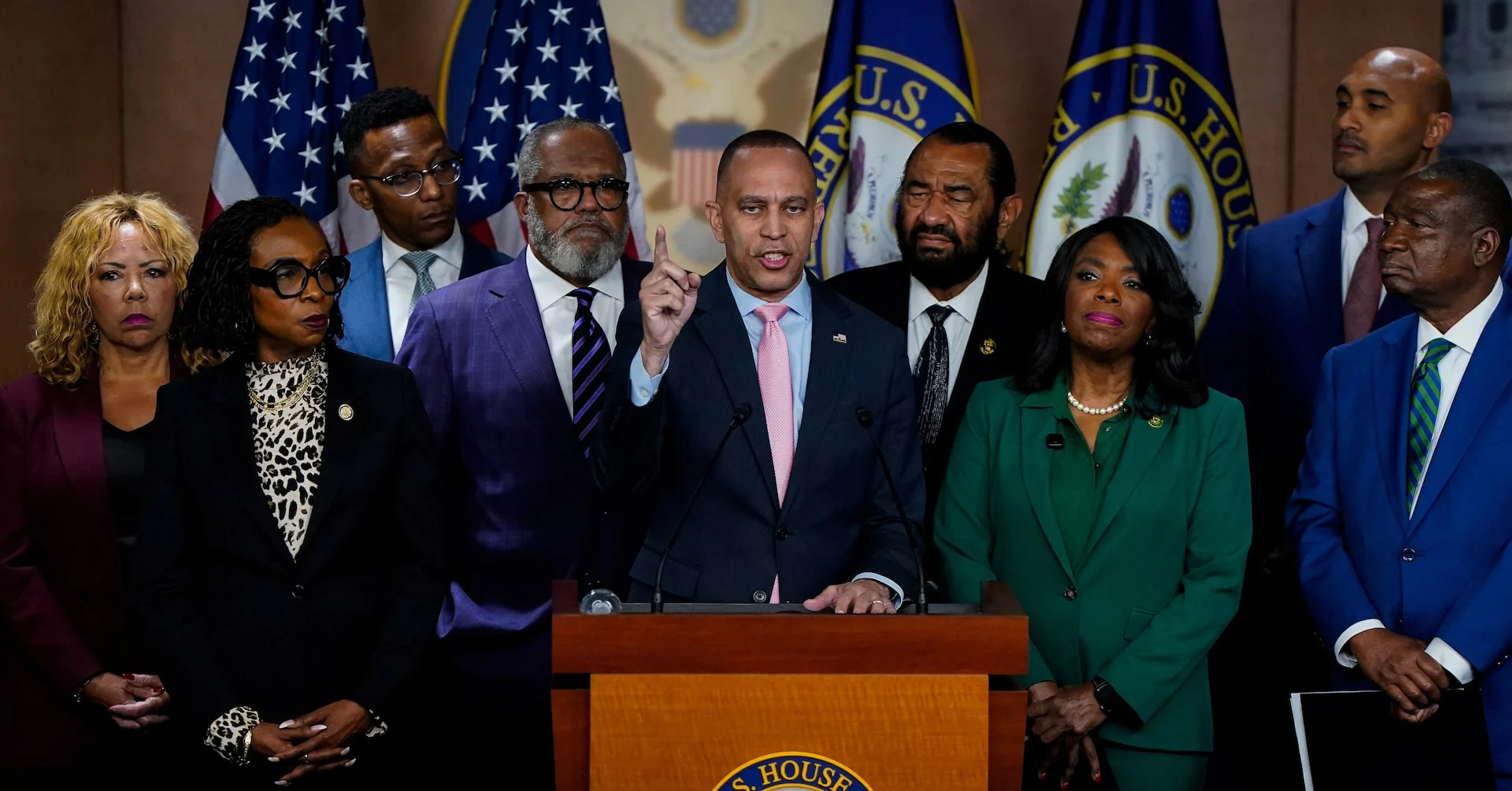
House Minority Leader Hakeem Jeffries is on course to become the first Black speaker of the House. Democrats hold internal leadership elections the week of Nov. 16, after which Jeffries becomes his party's nominee; he will need 218 votes on Jan. 3 to take the gavel and become second in the line of presidential succession.
Senator Chuck Schumer of New York is expected to return as majority leader. In remarks before the election, he summarized the party's intended message: "What we're going to do is lower costs, end all this rampant corruption and end the chaos. Plain and simple."
The practical consequences are substantial. Democratic committees will gain subpoena power and control of the investigative agenda, ending the period of minimal congressional oversight that the administration has enjoyed since 2025. The Senate will also have a say over any Supreme Court vacancy arising in Trump's final two years; several Democratic senators had already signalled they would not confirm a nominee.
The result may also shape the 2028 presidential field, though both parties caution that midterm waves do not reliably predict presidential outcomes.
What is already clear is the collision course. Trump has built his presidency on an expansive reading of executive authority, and Democratic leaders have campaigned on the promise of checking it. Neither side has shown much appetite for accommodation, setting up two years of institutional conflict with few recent parallels.
The last time the minority party won both chambers in a single night was 2006, when George W. Bush, facing backlash over the Iraq War, called the outcome "a thumping."
Sources: NBC News projections and exit polling; CNN Decision Desk and district-level analysis. Vote totals are as reported overnight and remain subject to change as counting continues.