
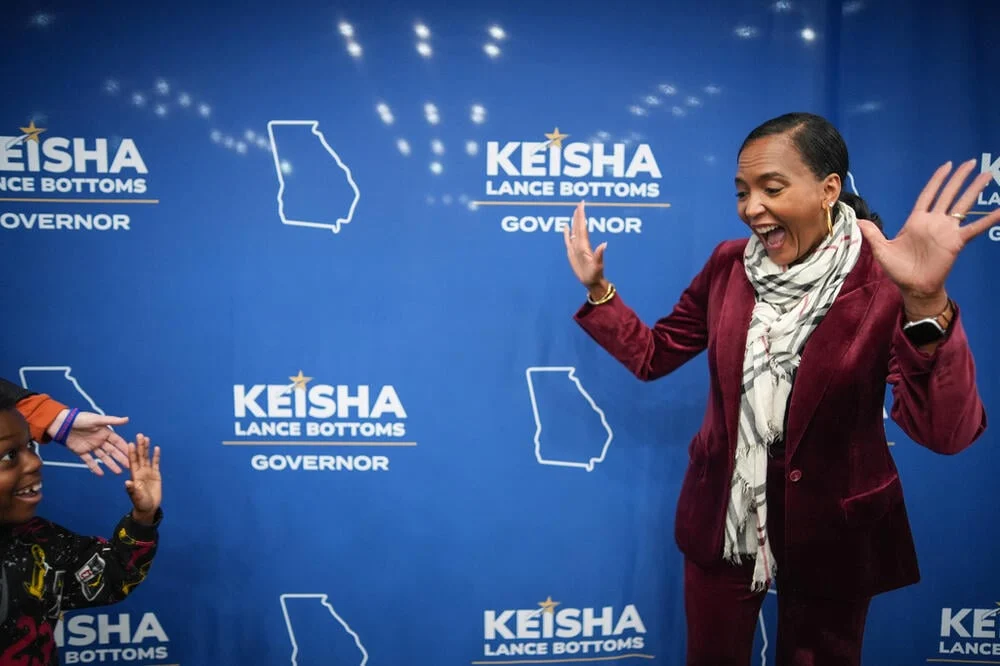
Democrats have won control of the U.S. House in the 2026 midterms, dealing a rebuke to President Trump. Keisha Lance Bottoms became the first Black woman elected U.S. governor, while Senate control hinges on Michigan and other uncalled races.
Democrats will take control of the U.S. House of Representatives, CBS News and NBC News projected late Tuesday, ending four years of Republican rule in the lower chamber and sharply limiting President Donald Trump's legislative room in the last two years of his term.
The result was driven less by any single race than by a broad swing toward Democrats on the cost of living, in an election held against the backdrop of a nine-month war with Iran and tariff-driven inflation. Early exit polling put Trump's approval rating at 38 percent, on track for the lowest figure recorded for a president in a midterm election, according to CBS News. Roughly six in ten voters said the president was a factor in their House vote.
A Senate still undecided — but tilting
Control of the Senate remained unresolved early Wednesday, though the map moved decisively in Democrats' favor. CBS News projected Democratic wins in North Carolina, where former governor Roy Cooper defeated Republican Michael Whatley for the seat vacated by retiring Sen. Thom Tillis, and in South Carolina, where pediatrician Annie Andrews unseated appointed Republican Sen. Darline Graham — the sister of the late Sen. Lindsey Graham. Democrats also held vulnerable seats in Georgia, where Sen. Jon Ossoff won reelection, and New Hampshire, where Rep. Chris Pappas prevailed.
Republicans defended Florida, and picked up seats in Kentucky, where Rep. Andy Barr succeeds the retiring Mitch McConnell, and Oklahoma, where Rep. Kevin Hern won. But CBS News rated Texas and Kansas as leaning Democratic, and Michigan as a toss-up. Texas has not elected a Democratic senator since 1988; Kansas has not done so in nearly a century. Democrats need a net gain of four seats to take the chamber, having so far flipped two, with Michigan's defense critical to their path.
Two senior Republican operatives involved in the party's Senate strategy told CBS News that election night could be severe. "It looks biblically bad," one said. A second was blunter: "Bloodbath."
Bottoms makes history in Georgia
The night's most symbolically significant result came in Georgia, where the Associated Press projected that Democrat Keisha Lance Bottoms defeated Republican businessman Rick Jackson to become the first Black woman elected governor of a U.S. state. With 82 percent of precincts counted, Bottoms held 54.4 percent of the vote. Jackson conceded shortly after 9 p.m. Eastern.
"Tonight the voters spoke, and I respect their decision," Jackson said. "Keisha Lance Bottoms deserves our congratulations and our prayers as she prepares to take office."
Bottoms, 56, a former Atlanta mayor and Biden administration adviser, will be the first Democrat elected Georgia governor in more than 20 years. She is likely to govern alongside a Republican-held state legislature, which would constrain her central promise to fully expand Medicaid. She also campaigned on eliminating the state sales tax on groceries at the municipal level, ending the state income tax for public school teachers, and a moratorium on new data centers in a state that leads the nation in such construction.
What Democratic control means
House Democrats will gain subpoena power in January, and party leaders have signaled an aggressive oversight agenda: the president's family business dealings, immigration enforcement, the Epstein case, Trump's pardons, and construction projects in Washington. Reps. Robert Garcia and Jamie Raskin, the top Democrats on the Oversight and Judiciary committees, are expected to lead that effort. Democrats will also control federal spending, giving them leverage to compel testimony.
House Minority Leader Hakeem Jeffries has said the party's legislative priorities are affordability: reversing Medicaid cuts enacted under the One Big Beautiful Bill Act, extending expired Affordable Care Act premium tax credits, ending the war with Iran, and rolling back tariffs. On a third impeachment of Trump, Jeffries has said Democrats have "haven't ruled anything out" and haven't "ruled anything in."
Whether he can hold the caucus together is an open question. Several newly elected democratic socialists, including the first Gen Z woman elected to Congress, Melat Kiros of Colorado, have declined to commit to supporting Jeffries for speaker. Moderates representing districts Trump carried in 2024 have already broken with the party on procedural votes.
The Republican collapse
Republicans entered the cycle defending a 218-seat majority that had at times functioned with almost no margin for defection. Speaker Mike Johnson's tenure was marked by repeated standoffs in which one or two members could stall the agenda. The party's redistricting push in Texas and Florida, which added 15 favorable seats across seven states, proved insufficient; California's counter-redistricting offset a portion of the gain.
Democrats flipped seats that had been Republican for years, including a North Carolina district held by the GOP for more than 15 years and Colorado's 8th District, where Rep. Gabe Evans lost to Democrat Manny Rutinel. In New Jersey, two-term Rep. Tom Kean Jr. was ousted by Democrat Rebecca Bennett.
Pete Buttigieg, speaking on CBS News from Michigan, described the results as "absolutely tectonic" and as "less of a result than it is a revolt." That characterization is a partisan one, and the size of the Democratic majority — and the Senate's final composition — will not be known until remaining votes are counted.