
Aleksandar Vučić conceded defeat in Serbia's snap parliamentary election, with the student-led Students' List projected to win 135-140 seats on near-record turnout of around 70%.
Aleksandar Vučić conceded defeat on Sunday in Serbia's snap parliamentary election, ending more than a decade of dominance by the Serbian Progressive Party (SNS) and handing victory to a student-led protest movement that emerged from two years of street demonstrations.
Speaking at SNS headquarters in Belgrade roughly an hour and a half after polls closed, Vučić said his party's projections showed the Students' List winning between 135 and 140 seats in the 250-member parliament, against around 105 for his own party. "The Students' List has won," he told supporters, adding: "It is clear that we have lost these elections."
Vučić said his party took roughly 1.7 million votes to the Students' List's 2.2 million. He attributed the result to what he described as hostile independent media coverage and interference by unnamed European countries and an "American deep state" — claims not supported by independent observers.
Record turnout, tense polling day
Independent monitor CRTA recorded turnout of 67.8% by 7 p.m. local time, up from 58.8% in the 2023 general elections and the highest level seen in Serbia since the October 2000 ballot that removed Slobodan Milošević. Monitors projected final turnout near 70%.
Voting was marked by tension in the capital. Police barriers were erected before noon on the street leading to the Central Election Commission, and riot-control vehicles were deployed in the city centre. CRTA programme director Raša Nedeljkov said citizens were prevented from approaching the commission to report irregularities — an unprecedented restriction in Serbia.
"We're sad that it's come to a point where European Parliament representatives need police protection while going around Belgrade and Serbia," Nedeljkov said. "Imagine what it's like for voters."
Monitors reported dozens of irregularities, including photographed ballots and suspected vote buying. Both domestic and international observers had raised concerns about campaign conditions, citing detentions, near-total government influence over broadcast media, and reports of surveillance and cyberattacks against activists.
From Novi Sad to a political earthquake
The protests began after 16 people died when a concrete canopy collapsed at the railway station in Novi Sad in November 2024. Demonstrators blamed the deaths on corruption and cronyism in the renovation project, and the movement grew into the largest in Serbia's modern history.
University students announced in May last year that they would contest the election, but none appeared on the ballot themselves. Instead, the list was composed of little-known professionals — doctors, engineers, farmers, athletes and artists — a deliberate design meant to counter Vučić's personalised rule. Campaigning largely by bicycle and on foot, the movement reached voters in rural areas that are traditional SNS strongholds.
"Never again to tyranny in our country," said Ilija Srdanović, who headed the Students' List roster. "We are moving toward a civilized and better Serbia."
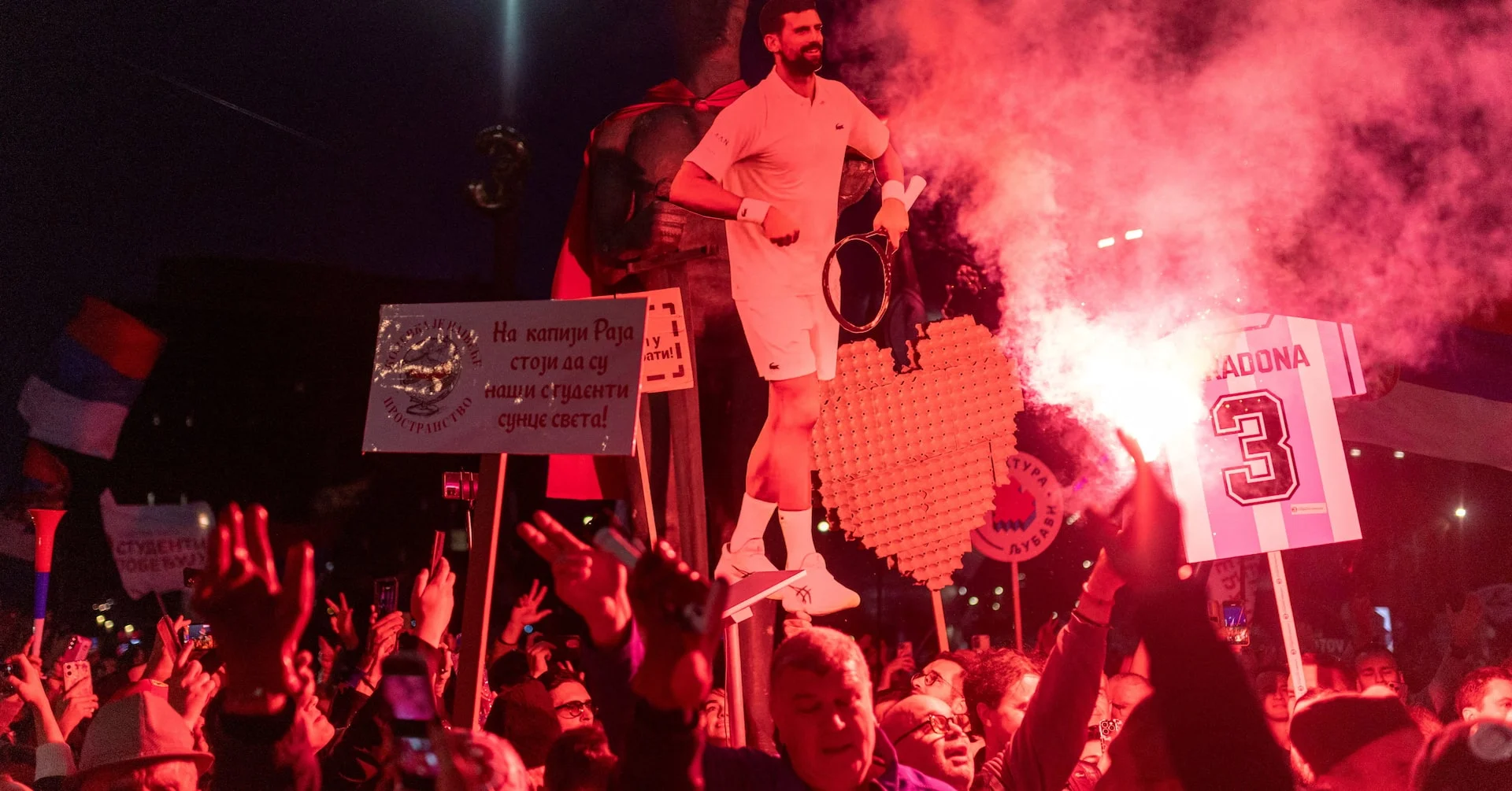
Crowds poured into central Belgrade as the result became known, chanting "Gotov je!" — "He's finished!" — a slogan first used during the 2000 revolution.
International reaction
European Commission President Ursula von der Leyen congratulated the Students' List, saying "the people of Serbia turned out in record numbers to shape their country's future." She said Brussels stood ready to support reforms on the rule of law, media freedom, the fight against corruption and democratic institutions, and to advance Serbia's path to EU membership.
Serbia has been an official EU candidate since 2012, but accession talks remain effectively frozen over rule-of-law and democracy concerns, as well as Belgrade's refusal to align with EU sanctions on Russia.
Vučić served as prime minister from 2014 to 2017 and then as president until resigning in September to lead the SNS into the election. Under his tenure Serbia was classified as an electoral autocracy by the Sweden-based V-Dem Institute and as only "partly free" by Freedom House. Reporters Without Borders, which named Vučić a "press freedom predator" in 2025, now ranks Serbia 104th globally for press freedom — last among the 40 countries of the EU and the Balkans.
What comes next
The result still requires formal confirmation by the Central Election Commission, which had not published official preliminary results as of early Monday. With a projected majority of 135 to 140 seats, the Students' List would be able to form a government without coalition partners, though it has not yet indicated whom it will nominate as prime minister.
The outcome echoes the defeat of Vučić's ally Viktor Orbán in Hungary, where youth turnout helped end 16 years of rule. It is likely to be read across Europe as a signal of how entrenched incumbents can be dislodged by diffuse, leaderless movements mobilised around corruption and governance.
Sources: Reuters, POLITICO Europe, CBS News/AP