
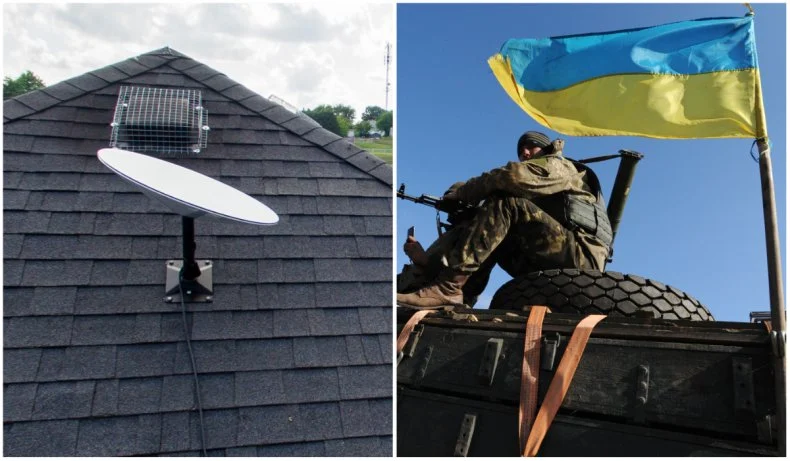
President Trump claims SpaceX CEO Elon Musk fully restored Ukraine's Starlink and Starshield access, but Ukrainian and European officials say speeds remain capped as Washington and Kyiv trade blame over who ordered the slowdown.
US President Donald Trump said on Thursday that SpaceX chief executive Elon Musk had restored Ukraine's access to the Starlink satellite network, but declined to say whether he had personally intervened, and Ukrainian and European officials said they had seen no improvement in the military-grade service Kyiv depends on for drone operations and air defence.
Speaking to reporters, Trump appeared to confirm that service had been degraded and claimed it was working again at full capacity. "I don't want to comment on it, whether I called or whether somebody else called, doesn't make any difference," he said. "The bottom line... he put it back."
What is in dispute
The Wall Street Journal reported this week that Musk personally capped the connection speeds available to Ukrainian equipment, rendering some of Kyiv's attack drones ineffective. The newspaper later reported, citing US officials, that Trump had called Musk and asked him to lift the restrictions.
Not everyone in the chain of command agrees on what happened, or who ordered it.
- Trump has denied directing any slowdown.
- Defence Secretary Pete Hegseth said the Pentagon issued no instruction to change Starshield operations.
- Secretary of State Marco Rubio said decisions on Ukraine's access rested with SpaceX and Musk, not the White House.
- Musk posted on X last week that "Starshield systems are owned and controlled by the US government" and that "any limits on speed or usage are decided by the US military and ultimately POTUS" — a formulation that points responsibility back to the president.
Starshield is the military-grade layer of SpaceX's satellite constellation, distinct from the commercial Starlink broadband service but built on the same infrastructure. Ukraine's armed forces use it for battlefield communications, drone control and air defence coordination.
Conflicting accounts of the service
Ukrainian President Volodymyr Zelensky said on Thursday, before Trump's latest remarks, that speeds on Starlink systems had not been restored for Ukraine. A senior European official told the Associated Press that nothing had changed in the operation of Starshield.
Some US and Ukrainian officials said the system had been working normally a day earlier. Zelensky said he hoped to hold talks with Rubio in the coming days.
The discrepancy matters beyond the technical question of bandwidth. If restrictions remain in place, Ukrainian units using satellite-guided drones for long-range strikes and interception face a persistent capability gap. If they have been lifted, the episode still leaves open the question of who has the authority to switch them off — and on what terms.
A wider breakdown in relations
The Starlink dispute lands amid a sharp deterioration in relations between Washington and Kyiv. Trump has recently announced a deal to buy Russian diesel, waived new sanctions on Moscow, urged Kyiv to halt attacks on Russian refineries and suggested Ukrainians should replace their president.
The shift has coincided with intensified fighting. Russia struck Kyiv with ballistic missiles and hit 12 regions of Ukraine overnight into Thursday, killing at least four people and wounding scores of others, including five children, according to Zelensky. Two women, aged 50 and 60, were killed in a strike on a market in Lozova in the northeastern Kharkiv region. Ukraine sent hundreds of drones towards Moscow.
Diplomatic fallout
The exchanges follow a meeting between US envoy Steve Witkoff and Vladimir Putin aimed at restarting peace talks. Witkoff described the Russian president as "humanitarian", a characterisation Downing Street rejected outright. A British government spokesperson said: "President Putin has killed thousands of people, both innocent Ukrainians and his own Russian people, who he has sent to their deaths on the frontline." Ukrainian Foreign Minister Andrii Sybiha said the latest Russian strikes showed "what Russian 'humanism' truly sounds like".
In Europe, Denmark said it had agreed to buy its first long-range precision missiles, with Defence Minister Jeppe Bruus saying the systems would allow strikes "behind enemy lines" if the country were attacked. The Russian embassy in Copenhagen warned of "inevitable disastrous consequences". Romania said it would accelerate development of surveillance and counter-drone capabilities in the Black Sea after at least seven cargo ships were hit near the coasts of Romania and Bulgaria in two weeks, with 30 sailors reported dead or missing.
Finland's prime minister, Petteri Orpo, said in Kyiv that no gas deals should be struck with Russia while the war continues, as Moscow pressed the EU to reconsider its planned ban on Russian liquefied natural gas imports.
What to watch
The immediate test is verifiable: whether Ukrainian units report restored speeds on Starshield, and whether independent US or European officials confirm it. Beyond that, the dispute has exposed an unresolved question about control of a privately owned network that a US ally's military now treats as essential infrastructure. Neither the White House nor SpaceX has published terms describing when, and by whose authority, access can be limited.